Skip to content
Cleverpod Vision
Pre-seed · Pre-launch · Saudi-anchored EV venture

One single Saudi small EV manufacturing platform.
For the road, the coast, and the sky.

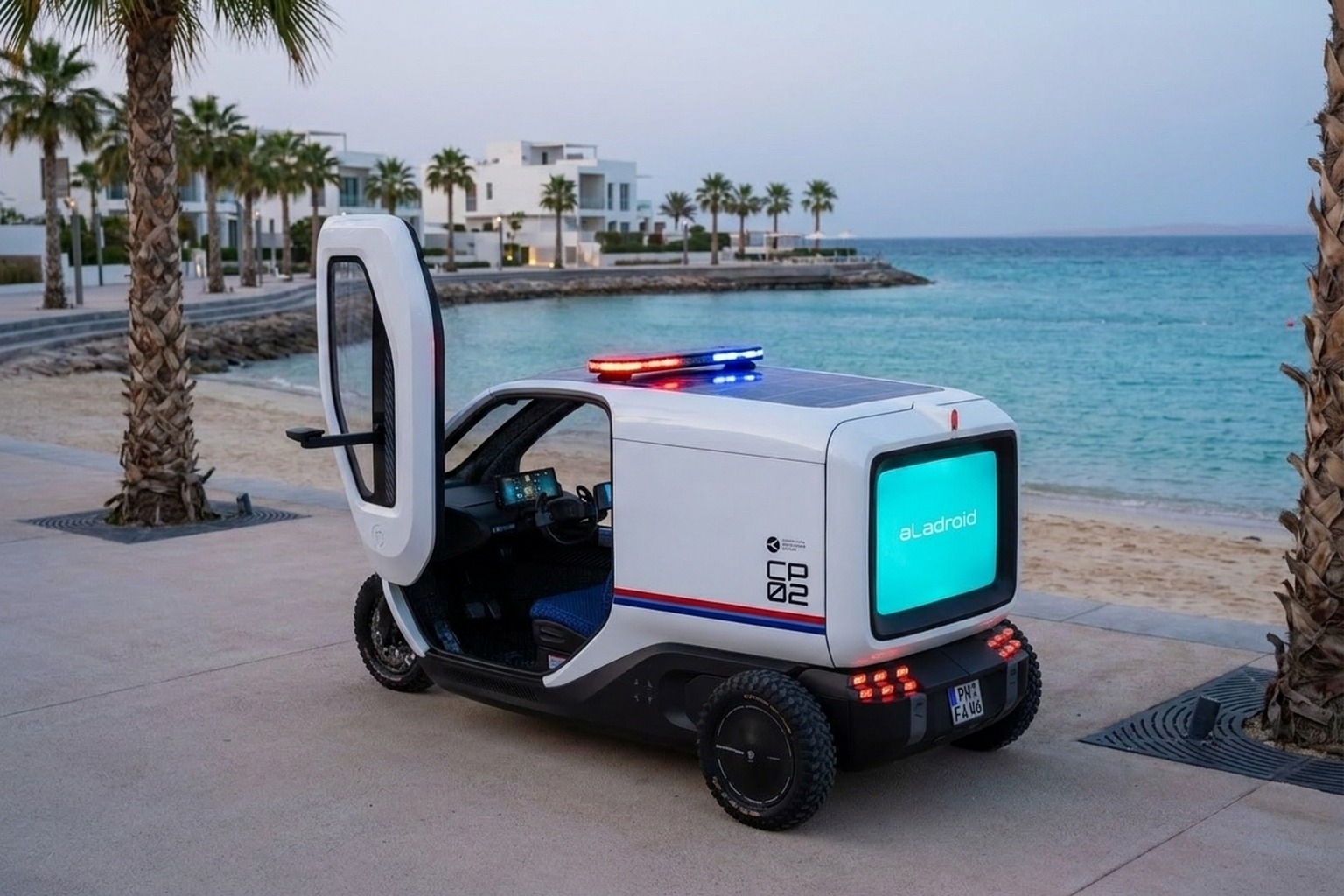
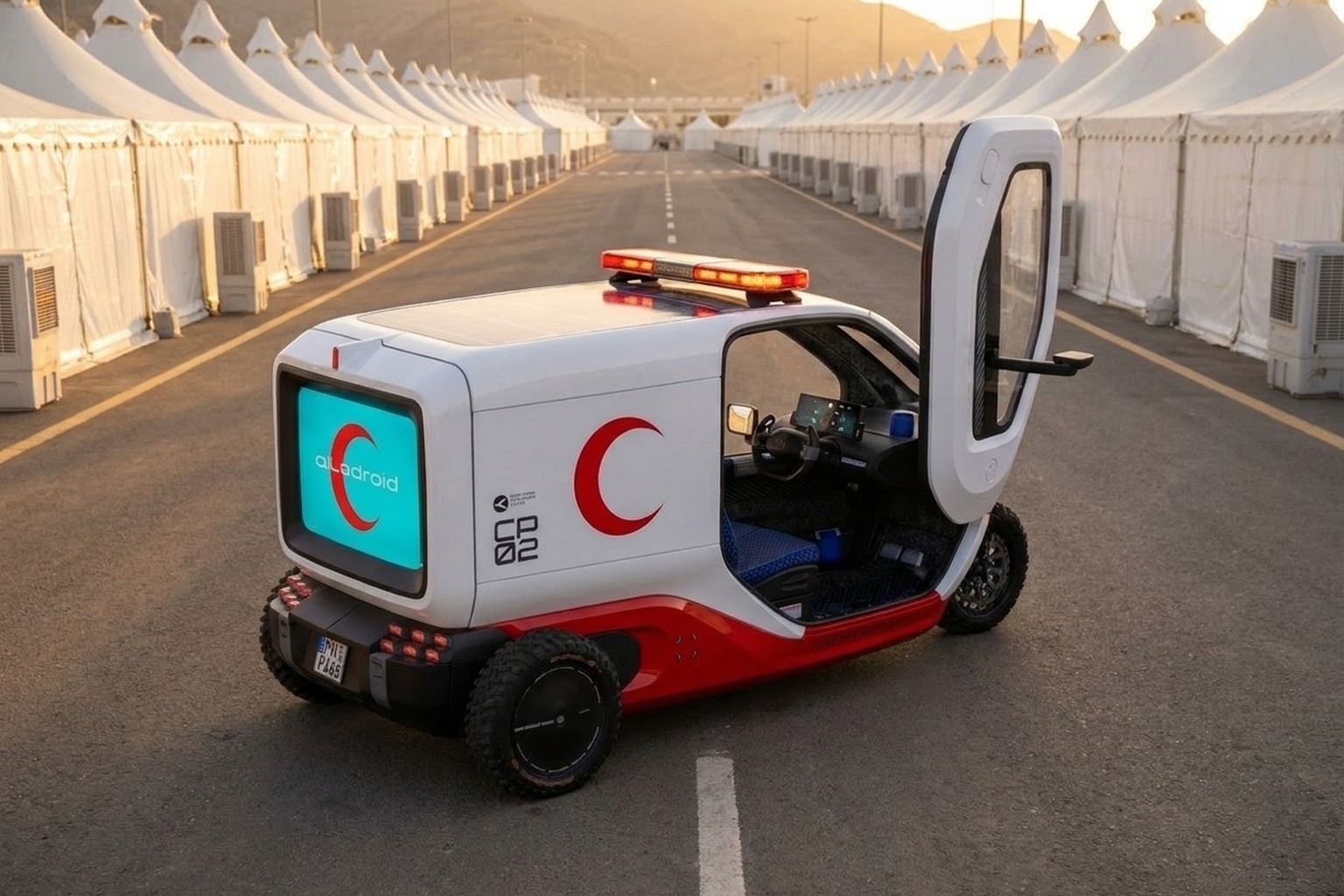
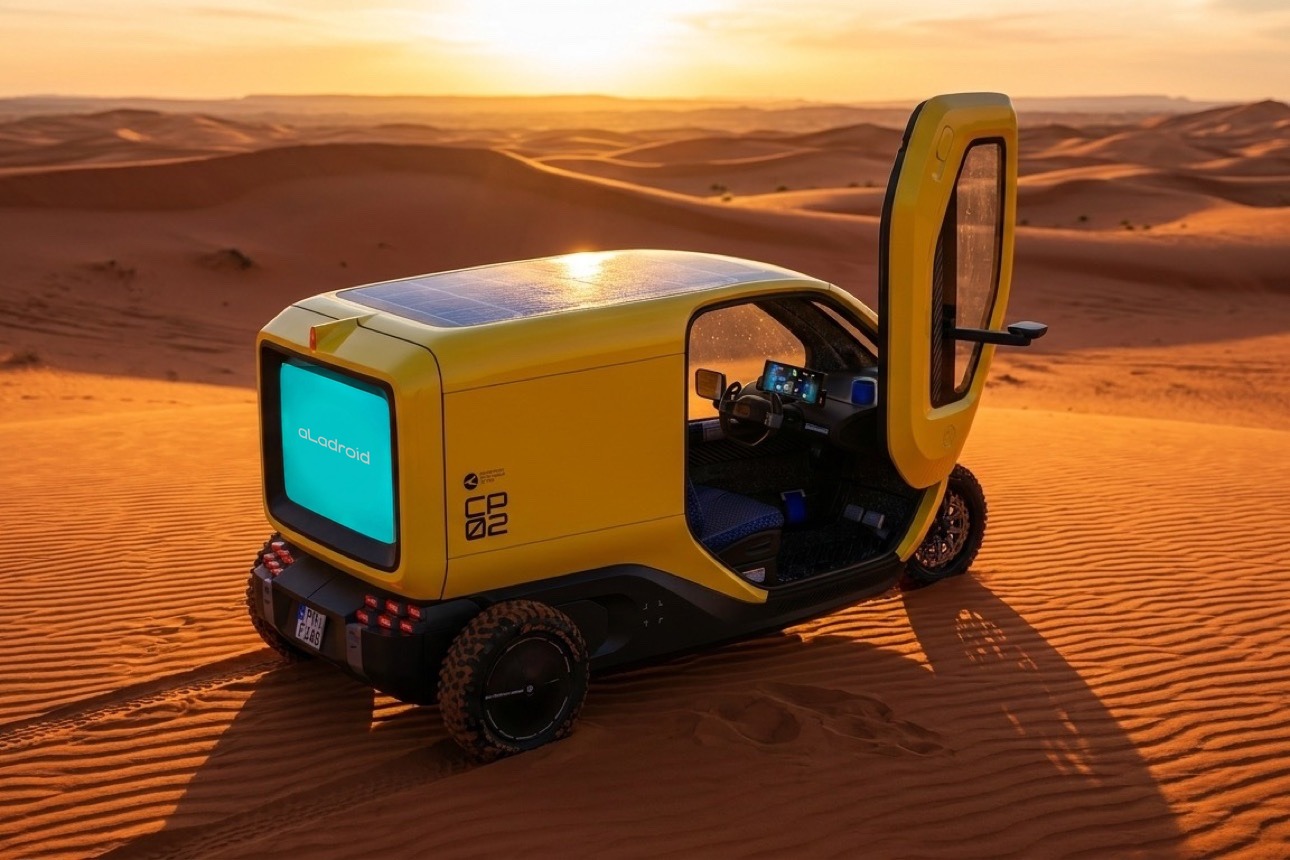
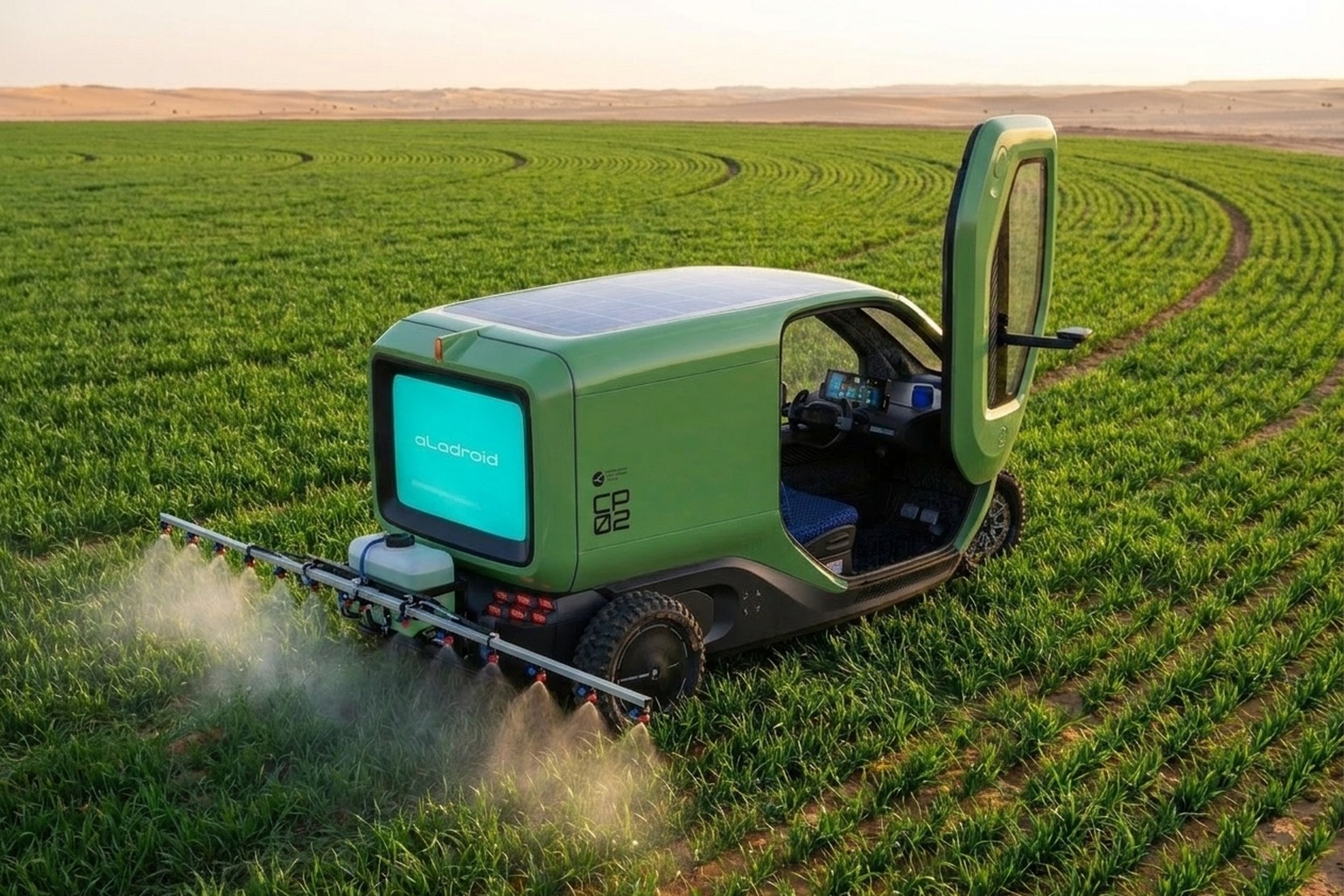
Imagine a single Saudi national champion addressing every Vision 2030 mobility need. The same drive, battery, and software carry a delivery three-wheeler through Riyadh, a robotic mini-vehicle spraying a Tabuk farm, a perimeter-patrol unit at a Red Sea Global resort, an emergency-response carrier at Hajj. Beyond the seed plan, the same platform reaches the 2,640 km Saudi shoreline as a coastal vessel and the Saudi sky as a cargo drone.

One Saudi-anchored manufacturer. One modular platform. A validated prototype proves the engineering; the rest of this page is how it scales.

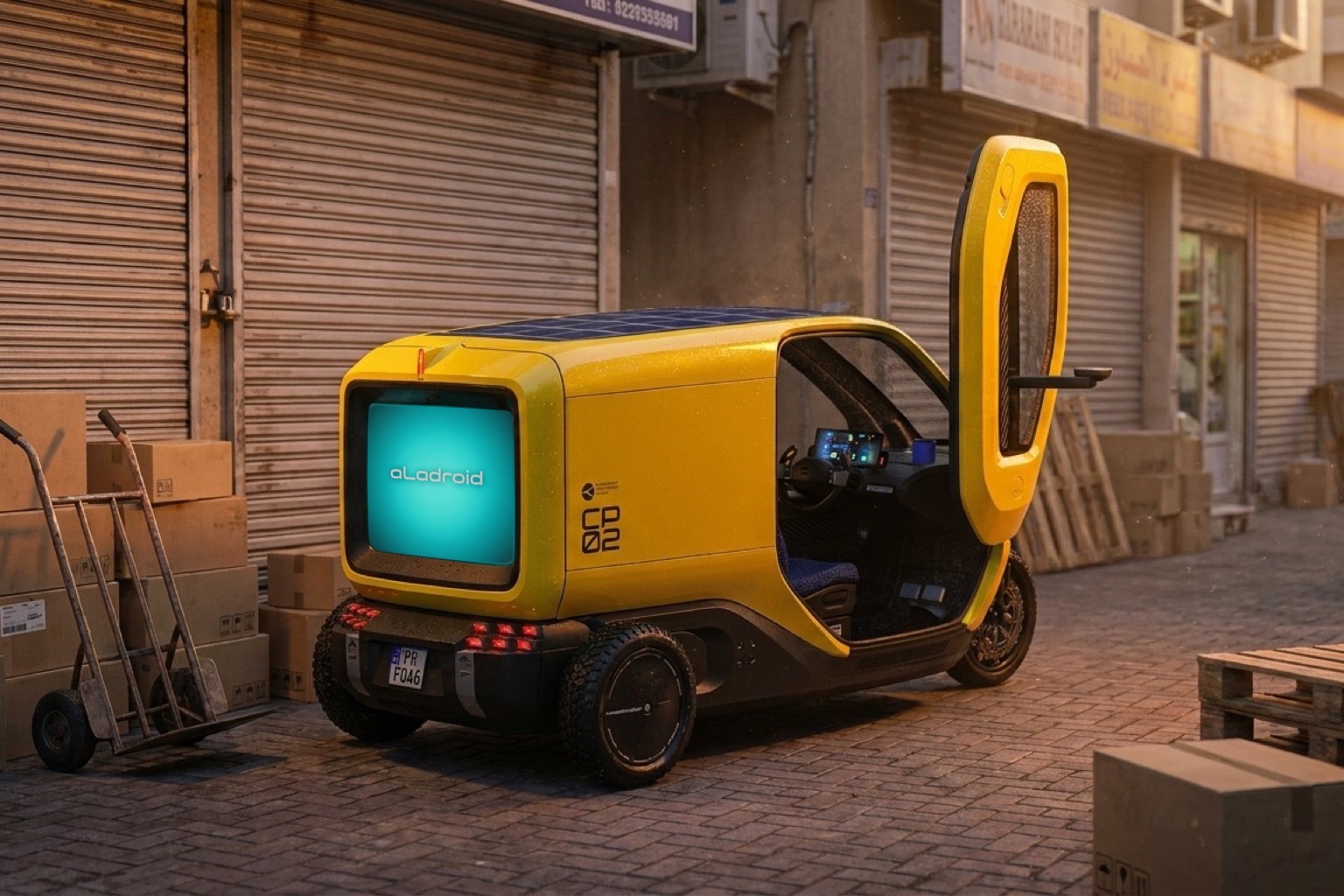
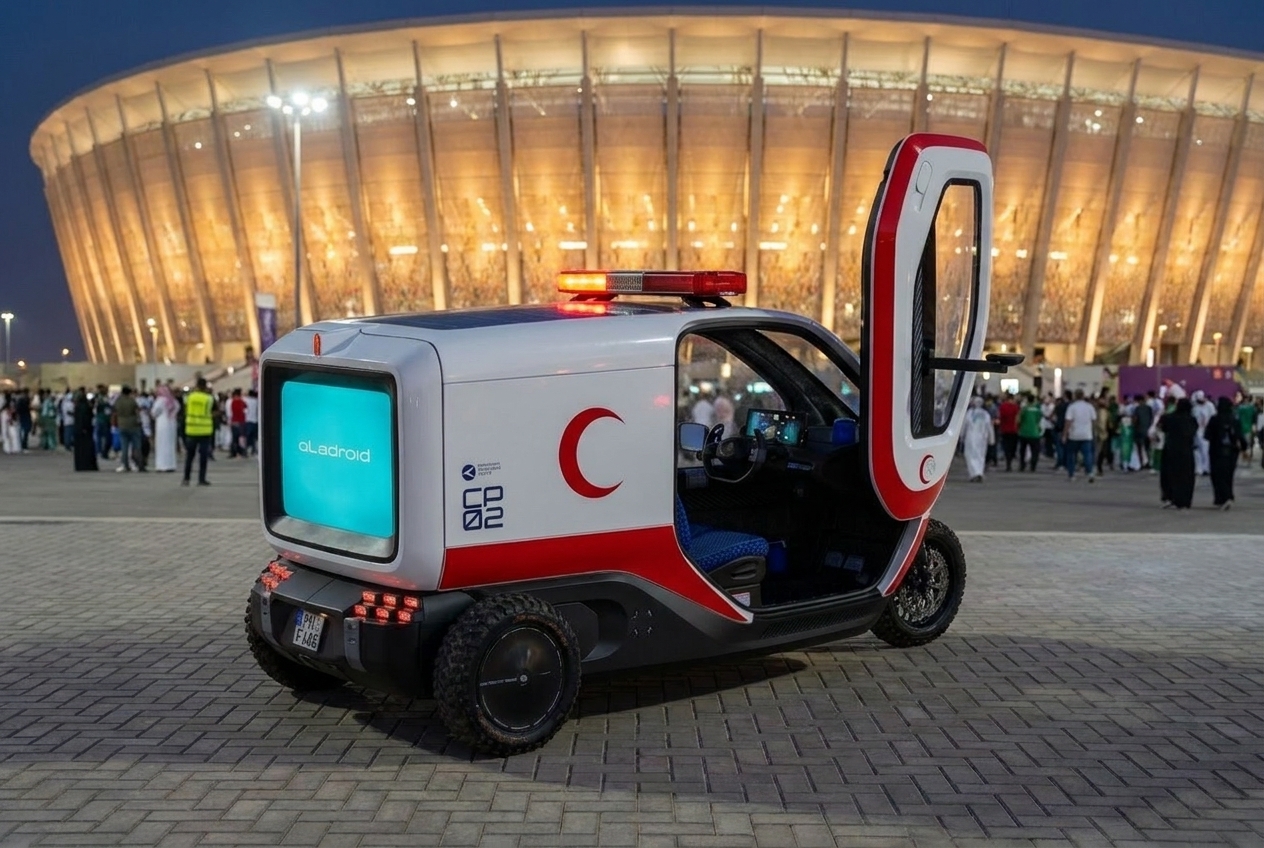
Cleverpod CP02 — concept render on the Riyadh Red Sands dunes, solar roof catching the light (illustrative livery)
CP02 on the Riyadh Red Sands — concept render, illustrative livery
National EV production target
500,000
Vehicles per year by 2030
src PIF
EVIQ fast chargers nationwide
5,000
Across 1,000 sites by 2030
src PIF · EVIQ
Saudi renewable electricity
50%
Target by 2030
src Saudi Green Initiative
Riyadh vehicles electric
30%
Target by 2030
src Royal Commission for Riyadh City
Executive summary

The deal in eight tiles.

What the venture is, why now, the product, the market, the unit economics, the projected returns, and the ask.

  1. 01 What

    Pre-launch Saudi-licensed small EV manufacturer. One modular platform — cargo, patrol, EMS, and long-horizon coastal and aerial variants. The financial model prices only the delivery cash cow; the wider range is roadmap upside on the same case.

    see Two parts of the case
  2. 02 Why now

    Five dated tailwinds underwritten by Saudi policy: PIF 2026-2030 Industrials & Logistics priority (Jun 2025), SASO cargo-trike (L5e-B) prohibition (in force 2024), Private Security Services Law amendment (May 2025), NEOM Green Hydrogen (2026), grid 50% renewables (2030).

    see Why now
  3. 03 Problem

    Saudi last-mile delivery runs on open-cab motorcycles in 45-50°C heat. TCO is lumpy, telemetry and SLA absent, liability sits with the operator, and the expat-rider headcount is misaligned with the Nitaqat trajectory.

    see Pod vs moto
  4. 04 Product

    CP02 — production-intent enclosed three-wheel pod, validated forward from the CP01 prototype, with delivery-fleet demand confirmed in writing by a Dubai last-mile operator running 450+ riders. Air-conditioned cabin rated for 45-50°C, ~240 km range against a ~145 km delivery shift, 660 L thermal cargo, 360° telemetry, sub-48h SLA.

    see Evidence and proof
  5. 05 Market

    Saudi delivery apps are a SAR ~31 bn market in 2025, growing to SAR ~73 bn by 2031 at 15.18% CAGR (Mordor Intelligence). By 2030 the planned fleet is ~10% of last-mile delivery vehicles and ~2.7% of that delivery-app spend.

    see Market size
  6. 06 Model

    Per-pod monthly subscription at SAR 2,399. 53.2% consolidated gross margin at maturity (27.9% at the Launch stage), depreciation-inclusive. Capex, service, insurance, accident coverage, and compliance sit with Cleverpod, not the subscriber. Bottom-up: ~60k pods by 2030 at a capacity-constrained ramp.

    see Unit economics
  7. 07 Returns

    Cash-cow-only projections. The model holds PIF in for about eleven years — capital across four rounds to 2029, dividends once the fleet self-finances, then a single EV/EBIT exit (SAR 17.0B, net of fleet debt) carrying ~89% of PIF's proceeds. It strikes that exit near 2037, on an assumed hold rather than a schedule. PIF MOIC 27.8×, IRR ~40.6%, NPV SAR 994.6M.

    see Returns
  8. 08 Ask

    Priced PIF equity into the planned Saudi operating company, raised in stages. The model funds the fleet with equity through Seed and Launch, then introduces asset-backed fleet financing from the Growth stage. Exact round sizes, ownership and financing assumptions are sourced from the model.

    see Ask

Each tile links to its full section below.

Two parts to the case

The delivery cash cow comes first.
The full range follows.

There are two distinct elements to the business.

The delivery cash cow is a subscription fleet: restaurants, supermarket chains, and pharmacies pay a monthly fee per vehicle that covers the vehicle itself, operator training, fleet software, insurance, compliance, and a defined uptime SLA. The subscriber pays one number; capex and compliance stay with Cleverpod.

The build-out of the full range — civil three-wheeler, modular robotic mini-vehicle, long-horizon coastal and aerial variants — reuses the platform's most expensive engineering: the same drive, battery, controller, and software stack. The cabin, hull, or airframe changes; the part that costs the most to design and certify does not.

The order is deliberate. The delivery business funds and de-risks the rest: it puts Saudi-built vehicles on Saudi streets at fleet scale, and the revenue, manufacturing learning, and regulatory approvals it generates are what pay for each next vehicle on the platform — not the seed round.

01
The delivery cash cow

Saudi first.
GCC and beyond later.

  • One product (CP02 delivery vehicle), one business model: a monthly subscription per vehicle bundling the vehicle, operator training, fleet software, insurance, compliance, and a defined uptime SLA.
  • Saudi ramp: Riyadh, Jeddah, and Dammam first; other Saudi cities to follow.
  • GCC and beyond: additional upside on the same engine, not assumed in the headline returns.
  • The financial model exclusively reflects the Saudi delivery fleet business, end-to-end.
02
Building out the full range

New vehicles, same platform.
Headquartered in Saudi, sold worldwide.

  • Cabins, hulls, and airframes vary; drive, battery, and software stack stay constant.
  • Long-horizon: coastal vessel and modular cargo / sensor drone. Beyond the seed plan.
  • Each new vehicle is additional upside, not assumed in the headline returns.
Cleverpod CP02 making a delivery in a narrow Riyadh souk service lane (concept render, illustrative livery)
CP02 in a Riyadh souk service lane — last-mile access a delivery van can't reach (concept render, illustrative livery).
Product roadmap

One platform. Many vehicles.

CP01 is the validated prototype — the proof that the engineering works. CP02 is the production-intent vehicle the planned Saudi fleet is to be built from. The roadmap then extends through a personal-use civil variant (CP03) and a modular robotic platform with plug-in payloads (CP04). Maritime and aerial variants share the platform but are not committed in the seed plan.

  1. CP01 2021

    Prototype delivery three-wheeler

    Three-wheel enclosed delivery pod, 300+ km range, 450 L modular thermal cargo. Validated prototype hardware that proves the engineering for the production-intent CP02. Not the deployed product.

    Validated prototype
  2. CP02 2026

    Production-intent delivery

    Production-intent delivery pod — chassis, interior, and steering geometry carried from the CP01 prototype. The design the Launch-stage Saudi fleet builds from, once the first prototype is completed and Saudi-certified.

    Production-intent
  3. CP03 2027

    Civil three-wheeler

    Personal-use urban three-wheeler reusing the CP01/02 drive, battery, and electronics. Same platform, different cabin and use case.

    Concept
  4. CP04 2028

    Robotic Membrane

    Modular robotic mini-vehicle. Plug-in payload modules cover agriculture, construction, environmental projects, and civil transport. The fullest expression of the platform thesis.

    Concept
  5. CP-S Beyond seed plan

    Sea variant

    Marine extension of the modular platform — coastal patrol, light cargo, port logistics. Not in the seed plan; labeled to make the platform reach legible.

    Platform potential
  6. CP-A Beyond seed plan

    Air variant

    Aerial extension — modular cargo or sensor drone reusing the same drive and software stack. Exploratory; not in the seed plan.

    Platform potential

Note — CP-S and CP-A are aspirational platform extensions, not products under active development. They are shown to make the modular thesis visible and are explicitly out of the seed-stage capital plan.

Land variant 1 — first deployed product

CP02: the production-intent delivery pod, deployed as a subscription.

The CP02 is the Cleverpod platform's first deployed body — the production-intent design proven out by the CP01 prototype. The target customer is a restaurant chain, grocer, pharmacy, or fulfillment operator. The proposition: a monthly per-pod subscription covering the vehicle, operator training, fleet software, and uptime SLA. The subscriber staffs the pod with its own operators; Cleverpod trains and licenses them. Capex, service, insurance, accident coverage, and compliance stay with Cleverpod.

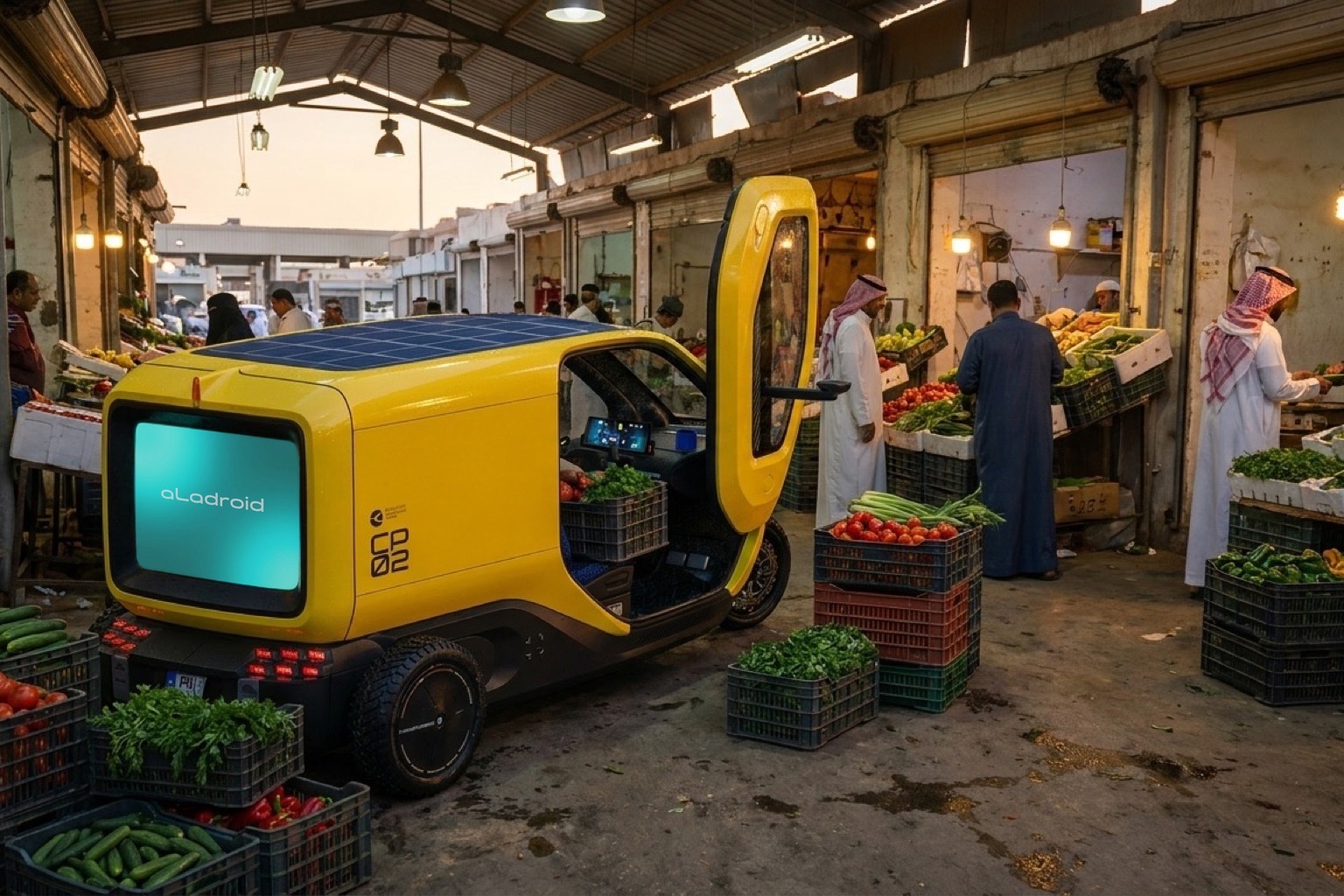
Cleverpod CP02 loading inside a narrow Riyadh wholesale-market service aisle (concept render, illustrative livery)
CP02 in a Riyadh market service aisle — concept render, illustrative livery
The pod

Enclosed electric delivery platform, engineered for Saudi.

Three-wheel enclosed electric delivery vehicle, built for Saudi heat and urban duty cycles. A 20 kW drive and a liquid-cooled under-floor pack give roughly 240 km between fast charges, against the ~145 km the model's own duty cycle puts on a pod in a working day, with a top speed designed to clear 100 km/h so the pod keeps pace on every road rather than obstructing traffic, while an R134a climate system holds the cabin, cargo, and battery steady in 45–50°C ambient. Modular thermal cargo (fridge, heater, insulated), telemetry, 360° cameras, and remote access come standard. Hardware platform from prior Shenzhen engineering work; production-intent units commission against the Seed-stage capital plan.

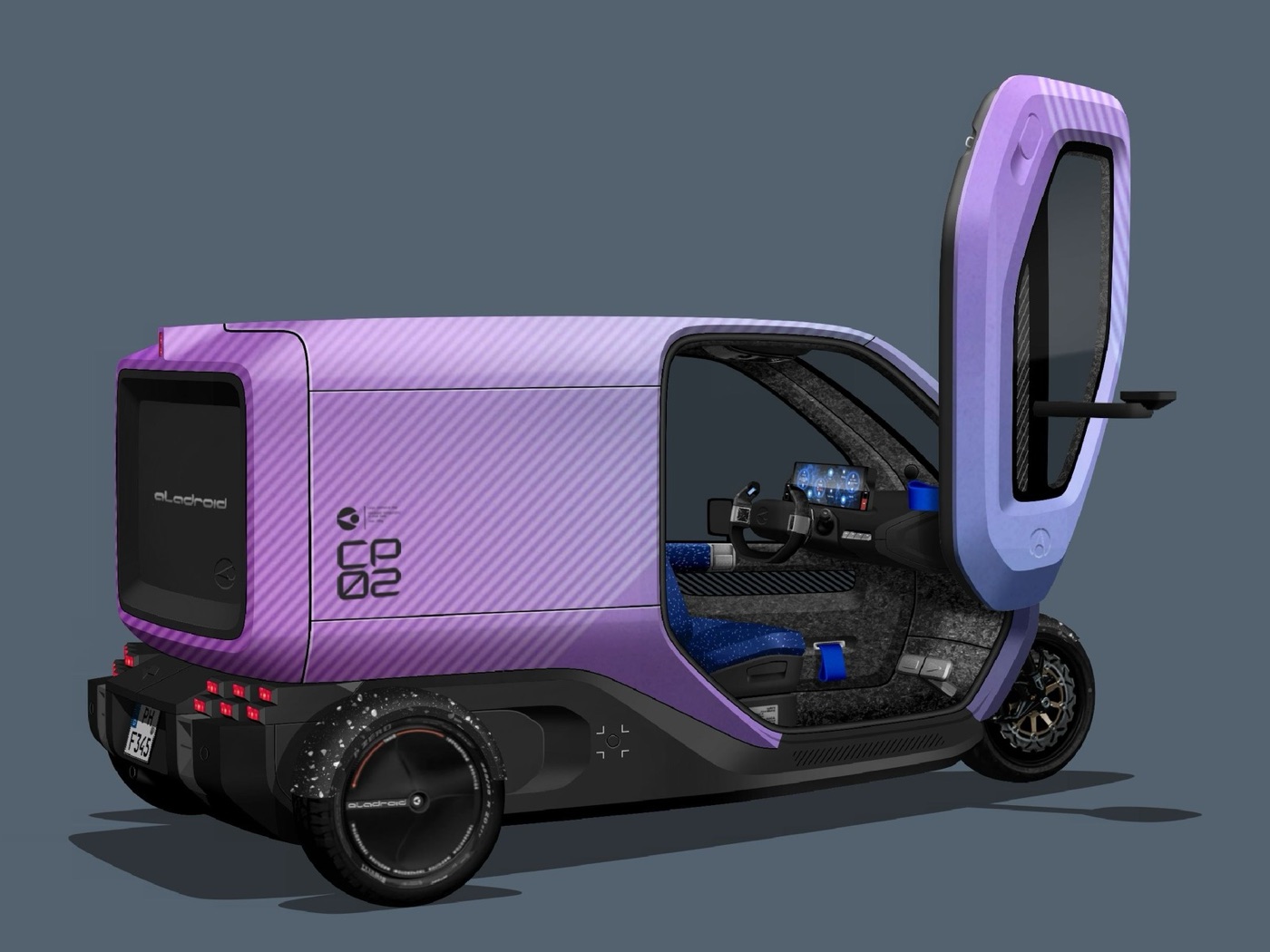
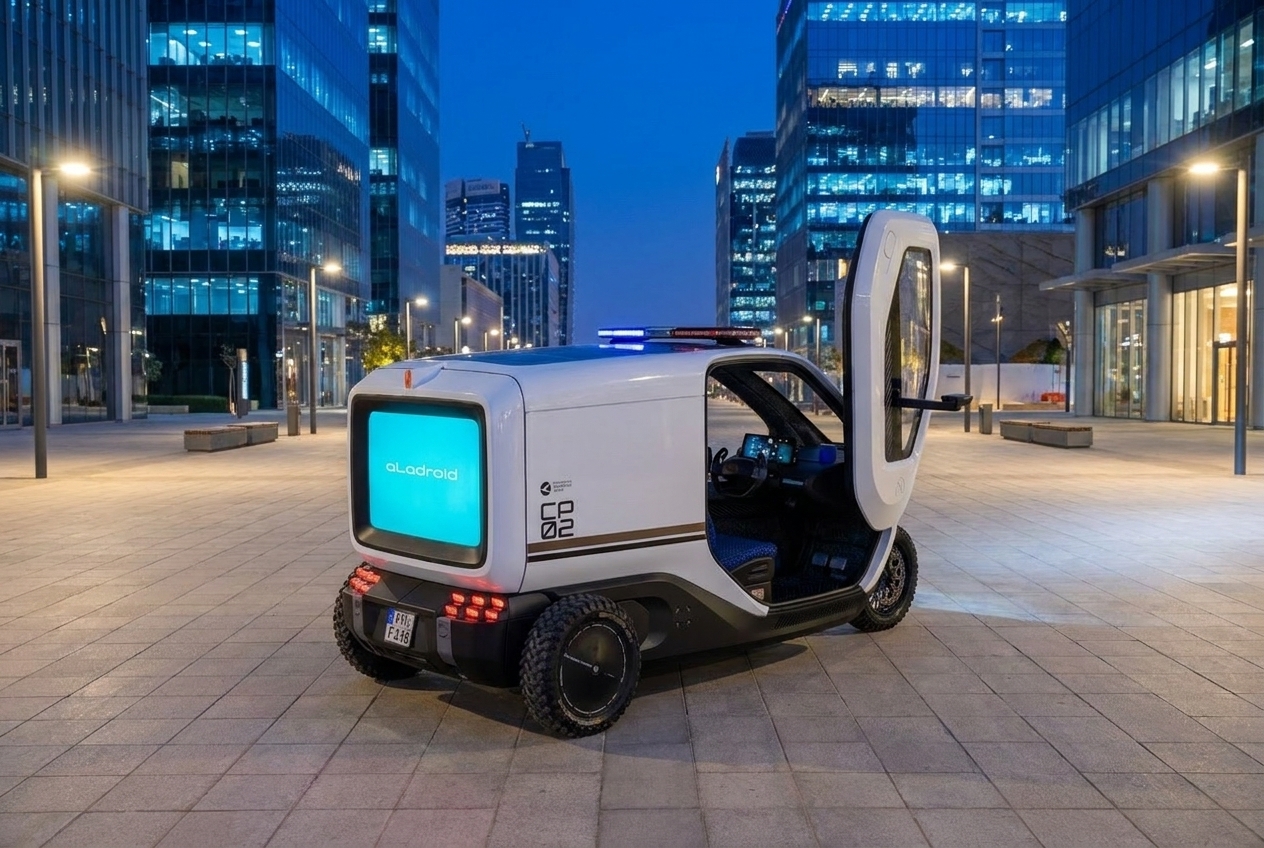
Cleverpod CP02 — production-intent design render, door open showing cabin and cargo (illustrative livery)
  • Form factorThree-wheel enclosed pod · 3.40 × 1.67 × 1.53 m
  • Drivetrain20 kW electric drive · Torsen-II rear differential
  • Battery21–26 kWh under-floor pack · liquid-cooled LiFePO4
  • Range≈240 km · ~25-min fast charge
  • Top speed≥100 km/h · full road & highway capable
  • ClimateR134a HVAC for 45–50°C · cabin, cargo & pack cooling
  • Cargo660 L modular thermal (fridge / heater / insulated)
  • SafetyDriver airbag · 3-point belt + pretensioners · occupancy interlocks
The software

Fleet operations stack, prototyped.

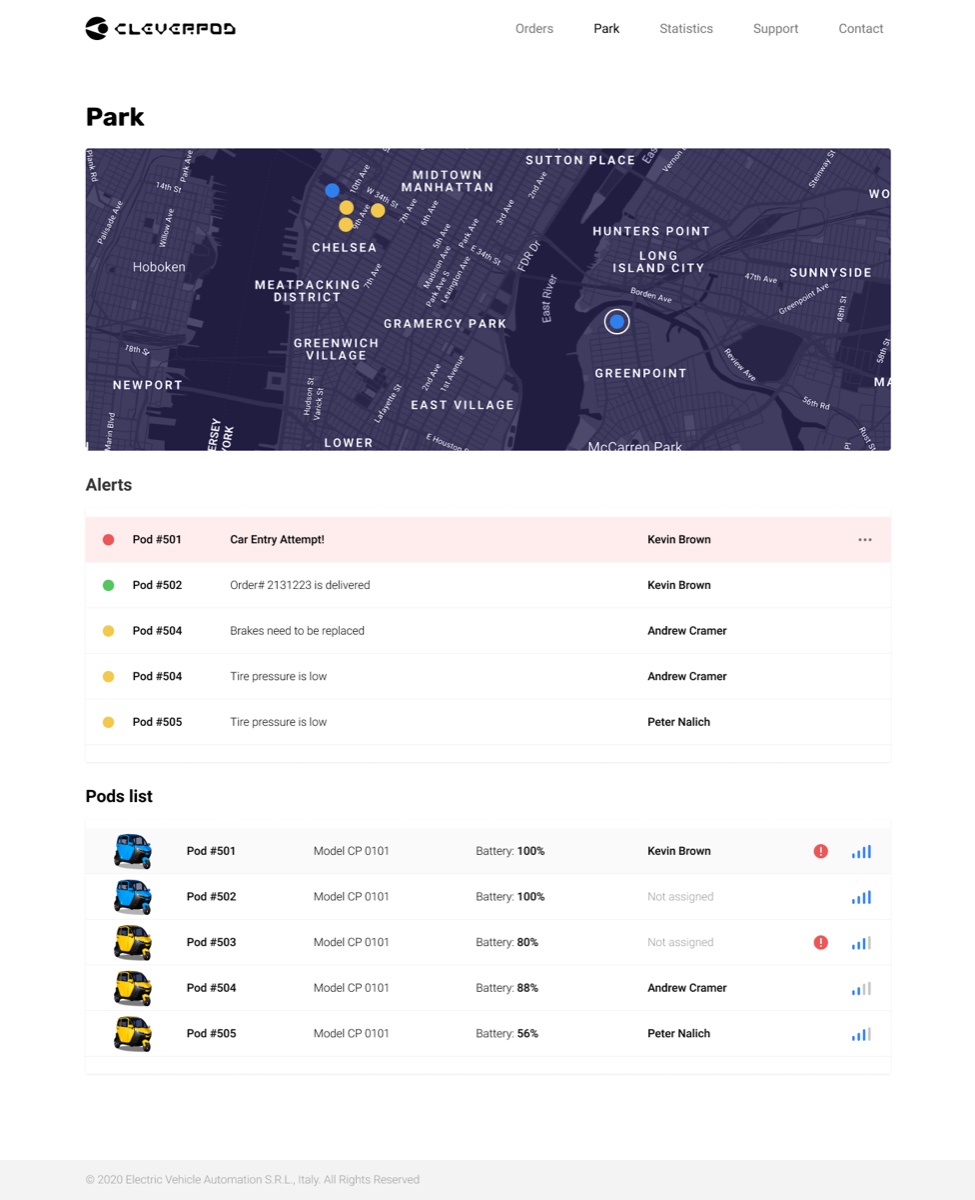
The CleverPod Remote Control Hub (admin, tablet, phone) runs on the CleverPod Bridge controller — a fleet operations platform, not a tracking app. Dispatch sees live location, battery state, and 360° video; operators are managed through geofencing, remote immobilisation, biometric access, and ADANEC AI scoring.

Cleverpod Remote Control Hub admin panel — live fleet map, alerts, and pod list
Admin · web
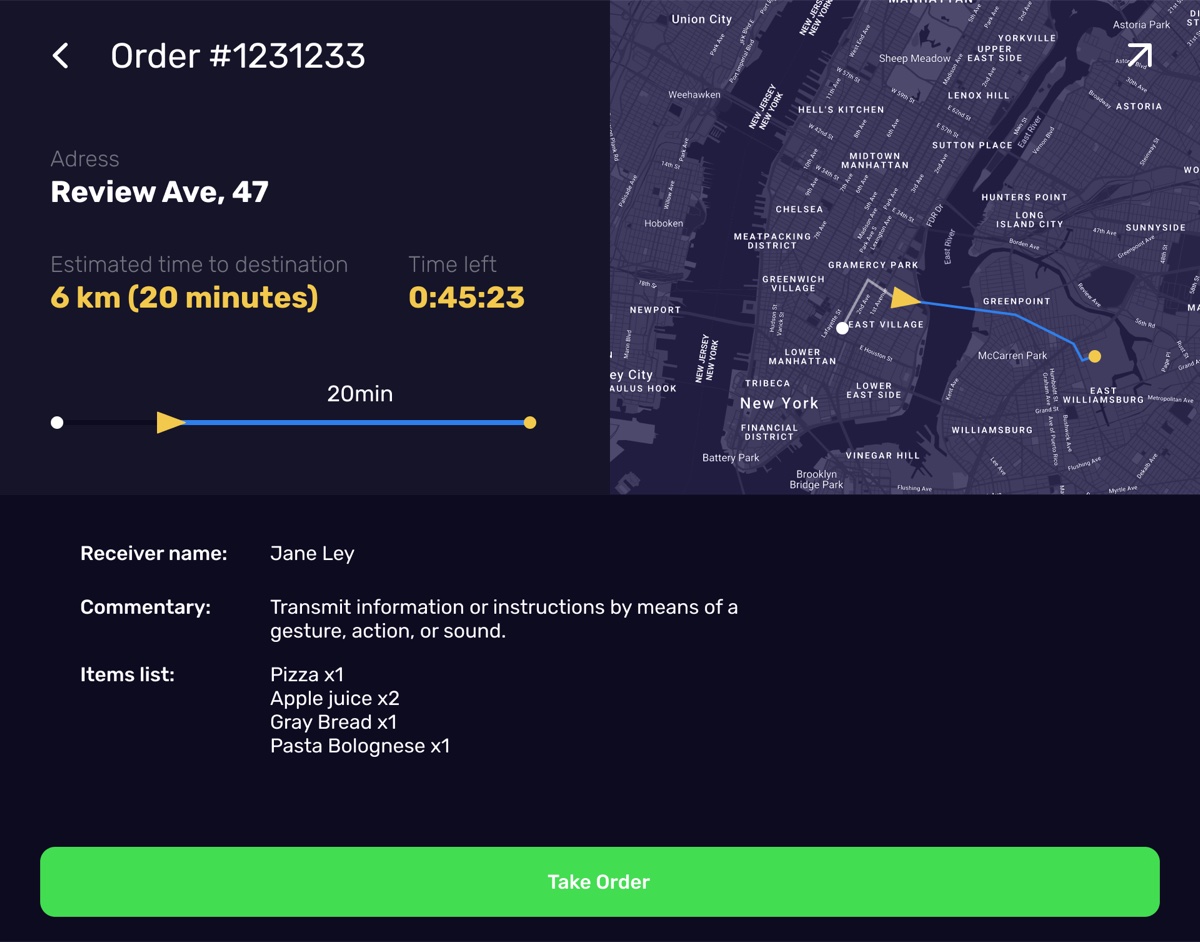
Cleverpod operator tablet — active delivery route, ETA, and order detail
Operator · tablet
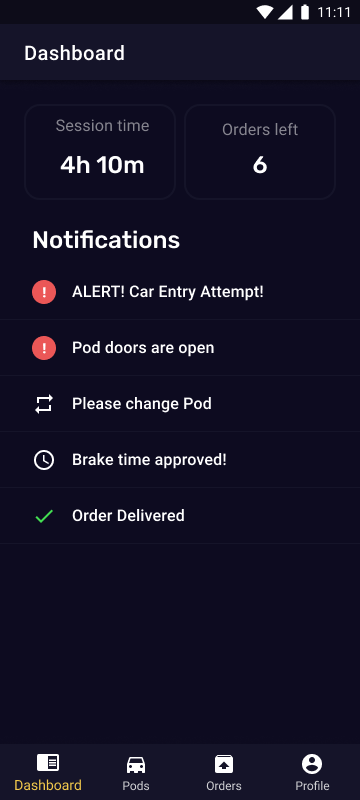
Cleverpod rider phone dashboard
Rider · phone
  • CP Remote Control Hub
  • CP Bridge controller
  • Geofencing + remote immobilisation
  • Biometric + alcohol-interlock access
  • ADANEC AI driver scoring
  • Battery-aware routing
  • White-label + logistics integration
  • Cloud-synced operator profile
The service wrapper

One subscription, designed for predictable TCO.

The subscription price covers preventative maintenance, scheduled battery replacement, insurance pass-through, Saudi compliance and driver licensing, and a defined uptime SLA. The subscriber pays one monthly number; Cleverpod retains the capex and compliance burden.

  • Maintenance
    Scheduled service, centralized parts, sub-48h SLA on breakdown.
  • Battery
    Replacement on kWh throughput schedule; no subscriber exposure to pack degradation.
  • Insurance
    Pass-through fleet policy; Saudi-compliant coverage bundled.
  • Compliance
    TGA, ZATCA, licensing and driver-training support end-to-end.
  • Uptime SLA
    Defined target (see data room); sub-target triggers fee relief.
  • Ownership
    Cleverpod owns the asset; subscriber never carries resale risk.
Mobility as a service

Not just a vehicle — a fully managed fleet.

Cleverpod sells mobility as a service, not a vehicle. The fleet operator pays an ongoing service tariff rather than buying hardware once. This tariff absorbs the operating system an operator would otherwise build and staff itself: compliance, dispatch, repair, insurance evidence, and end-of-life. What was once cost and overhead becomes leverage for everyone involved.

For the fleet operator

  • Back-office and compliance fold into the platform. Pre-trip medicals, waybills, hours-of-service tracking, and pre-dispatch inspections are automated via telemetry. Dispatch, routing, and charge management run in software. Staff move from paperwork to customers.
  • Repair and recovery are handled end-to-end. Cleverpod manages the workshop, parts, and towing—even after at-fault accidents. No in-house garage, no separate recovery contracts.
  • The pod ships as a complete stack: operator tablet, fleet software, and modular hardware (cargo, scanning, X-ray).
  • Subleasing is permitted: companies can re-let unused capacity, or offer subscriptions directly to individual riders.

For the insurer

  • Onboard 360° cameras and sensors document every trip and incident.
  • Payouts rely on recorded evidence, not disputes—ensuring faster settlement and a cleaner basis for fleet pricing.

For the Kingdom

  • End-of-life recycling is absorbed by Cleverpod's lifecycle and parts-reuse model.
  • Operator protection: the platform ensures a safe, regulated working environment.
  • Fleet telemetry provides transport planners with real last-mile data.
  • Public and private emergency services can scale on the exact same platform.
AI platform

MOYA: the in-house AI platform running the fleet.

Every Cleverpod ships as a connected, sensor-rich vehicle — and MOYA is the software that makes the fleet worth more than the sum of its pods. Built in-house by Cleverpod's Shenzhen R&D team, MOYA is the AI and fleet-intelligence layer beneath the CleverPod Bridge: it plans routes, distributes orders, scores drivers, assists operators, and turns every trip into proprietary data.

Fleet intelligence

Dispatch, routing, and order distribution run as optimisation, not guesswork. Battery-aware routing keeps pods on-shift; ADANEC AI scoring rates every driver on safety and delivery quality; the same models schedule maintenance and balance load. Utilisation compounds as the fleet grows.

Assistant & language

A virtual assistant spans the operator tablet, the Remote Control Hub, and the rider app, built on a microservices and neural-network architecture. Operators ask in natural language and get answers from the fleet's own knowledge base — onboarding, compliance, and support without a call centre.

Data engine

Every pod carries 360° cameras, GPS, and full telemetry. MOYA turns that stream into a proprietary last-mile dataset — road conditions, delivery patterns, driver behaviour — that sharpens routing and scoring over time and lays the groundwork for supervised autonomy.

MOYA runs on cloud infrastructure with a dedicated GPU compute cluster, built and operated by Cleverpod's own engineers rather than licensed in — the same platform already behind the CleverPod Bridge and ADANEC scoring, now resourced as a core workstream from the first funding stage.

Evidence and proof

From narrative to artefact — five things you can ask to see.

Five verifiable artefacts Cleverpod has standing today, each with its status and the underlying document.

verified · artefact in hand scheduled · planned, not yet in hand data room · available under NDA
verified

CP01 prototype, real-environment photograph

The CP01 hardware exists. The photograph below is of the validated prototype that established the engineering inputs to CP02. More images are available in the data room.

Cleverpod CP01 prototype, full three-wheeled enclosed delivery pod, photographed in a real urban setting.
CP01 prototype · photograph — more images in the data room
verified

Confirmed delivery-operator demand — signed LOI

A Dubai-based last-mile operator — 450+ riders, a fleet of commercial vans and motorcycles, already running 50 trial EV scooters for a major global e-commerce client and food aggregators — has put its demand for the CP02 in writing. After seeing the CP01 live, the operator's e-commerce client confirmed interest conditional on a GCC-standard, liquid-cooled vehicle for the summer heat — precisely the CP02's design point. The letter sets out the gap the CP02 fills against an EV scooter: 660 L of customizable cargo versus 60 L, roughly 4× the orders per day, year-round operation, and driver safety.

  • Signed letter of intent — Dubai last-mile delivery operator (counterparty named in the data room)
  • Operator's CP02-vs-scooter comparison: 660 L vs 60 L cargo, ~4× orders/day, 365-day operation, cooling tested to 55°C
Source Signed operator LOI — counterparty named in the data room.
scheduled

IATF 16949 quality system — Saudi assembly line

The GSO / SASO technical regulation for electric vehicles requires the producing factory to hold an IATF 16949 quality-management certificate (or equivalent) as part of the EV Certificate of Conformity. CP02 is SKD-assembled in Saudi Arabia from the Seed stage — components are produced in Shenzhen and shipped as knocked-down kits — so the Saudi assembly-and-QC line is the site that carries this certification. Certifying that line is a Seed-stage build item; as a fallback, the first CP02 deployment fleet can be sourced through a SASO-recognised IATF-certified partner factory while the Saudi line completes certification.

  • GSO / SASO EV technical regulation — the IATF 16949 (or equivalent) factory requirement
  • Planned IATF 16949 certification of the Saudi assembly line (targeted in the Seed stage)
  • Fallback: first deployment fleet via a SASO-recognised IATF-certified partner factory
Source Seed-stage certification workstream with a SASO-recognised partner-factory fallback
data-room

Bill of Materials — full CP02 component list

The full CP02 Bill of Materials lives in the financial model: every component with its per-line cost, useful life, and service venue, exposed through the BOM_* named ranges and wired directly into the per-pod unit economics. A standalone BOM document is in the data room.

  • CP02 Bill of Materials — full component list with per-line costs, in the BOM Inputs sheet of the financial model (BOM_* named ranges)
  • CP02 BOM v.1.pdf (data room)
Source See data room · Financial model
data-room

CP02 engineering development & validation plan

The CP02 program runs on a staged engineering plan: requirements analysis and CAD, a design FMEA (DFMEA), and prototype builds of the battery liquid-cooling system, cabin climate control, and the driver-safety system (seatbelt, external and internal airbag). The concept stage and its engineering documentation pack are complete; the next stage covers prototype assembly, unit testing, and validation/homologation along the certification path.

  • CP02 development plan — staged scope and phase status
  • Design FMEA (DFMEA) — in the engineering pack
  • CAD / CAE documentation — chassis, drivetrain, battery cooling, climate, safety systems
Source See data room
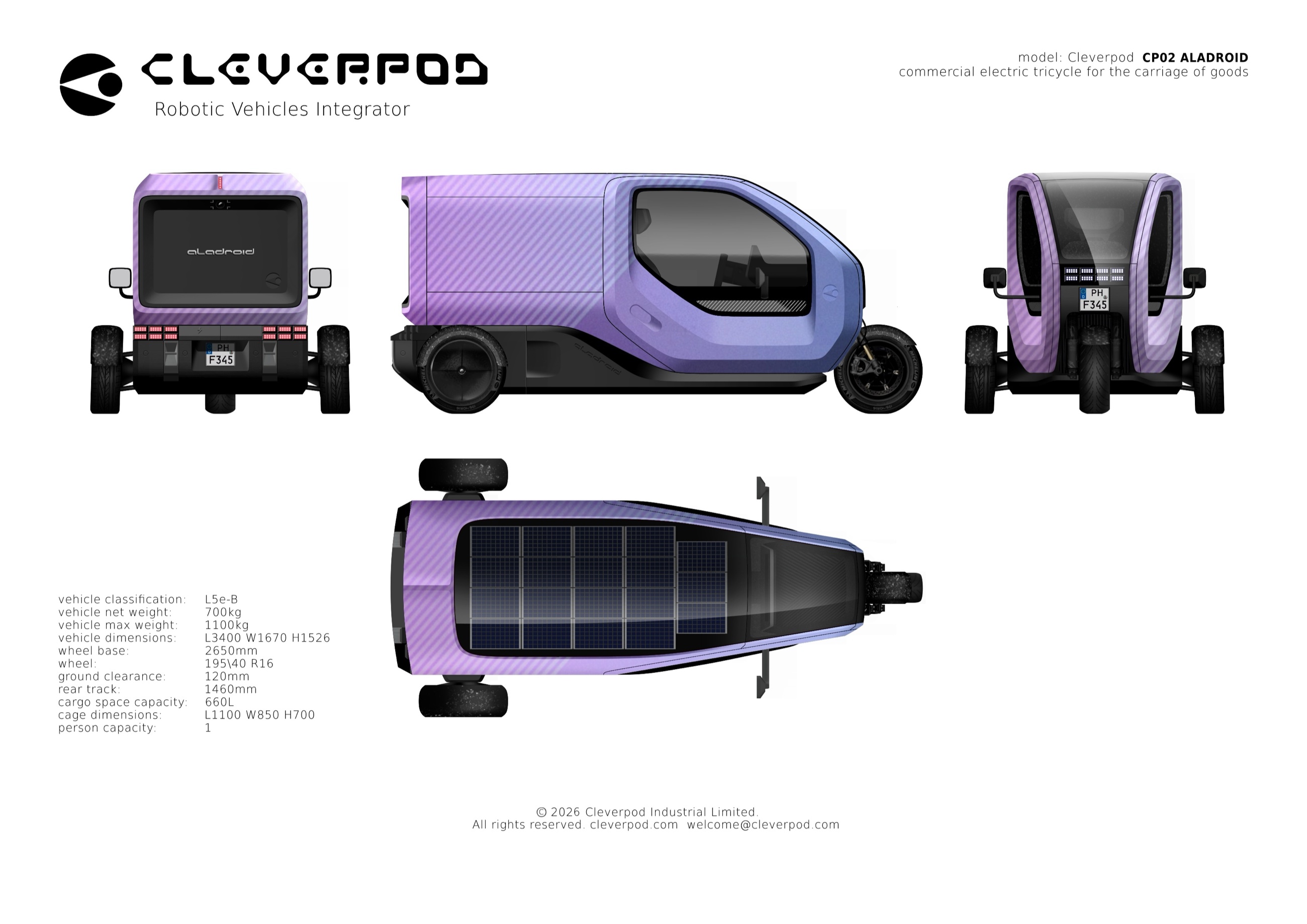
Cleverpod CP02 Aladroid — design specification: front, side, rear and top views with dimensions
CP02 ‘Aladroid’ · design specification — production-intent
Why the delivery pod wins

The motorcycle is the problem.
The pod is the fix.

Riyadh's summer regularly exceeds 45°C: a motorcycle rider is working in extreme heat for an eight-hour shift, unprotected from traffic, breathing fumes, carrying food and pharmaceuticals in a backpack with no reliable means to maintain their temperature. The fleet is unmanaged and largely unmonitored, encouraging aggressive driving to maximize income.

There is a solution: its name is Cleverpod.

Click any advantage to compare the status quo against the pod.
01 Operator welfare
Motorcycle (status quo)

Exposed rider, no climate control. In Riyadh's 45-50°C summers, sustained outdoor work in full protective gear is a welfare and productivity liability.

Cleverpod

Enclosed cabin with A/C, heating, and lumbar-support seating. The operator works a full shift in comfort at any temperature — same vehicle from December cold to August heat.

02 Operator safety
Motorcycle (status quo)

Exposed two-wheeler in mixed urban traffic. Rider injury risk is high; insurance and liability sit with the operator.

Cleverpod

Enclosed three-wheel platform — a middle ground between a car's crash protection and a bike's urban mobility. Insurance, licensing, and compliance are bundled into the Cleverpod subscription.

03 Workforce localisation (Nitaqat)
Motorcycle (status quo)

The rider pool stays overwhelmingly expat — few nationals take the job — so operators sit below their Nitaqat band, carrying a Saudization shortfall and a rising expat levy on every head.

Cleverpod

A role nationals will actually take, which widens the local hiring pool and lifts the operating company's Nitaqat standing — turning a compliance cost into a hiring advantage. Localisation is in the hardware, not just the org chart.

04 Emissions
Motorcycle (status quo)

Petrol drivetrain with no emissions management. A full working shift generates CO₂ and urban particulates. No mechanism reduces output as a fleet scales — the environmental cost scales directly with volume.

Cleverpod

Zero tailpipe emissions at the point of use. The same vehicle gets materially cleaner over time as Saudi's grid mix shifts toward its 50% renewables target under Vision 2030 — no hardware change required.

05 Cargo integrity
Motorcycle (status quo)

Insulated backpack at best. Temperature-sensitive cargo — food, pharma, cold-chain grocery — degrades in transit. No temperature record, no accountability.

Cleverpod

Modular thermal cargo system from -20°C to +65°C. 660 L enclosed space with configurable fridge, heater, insulated, and fresh compartments. Temperature-controlled from door to door.

06 Cargo security
Motorcycle (status quo)

An unlocked box or an unattended backpack. No alarm, no record of tamper, no remote visibility.

Cleverpod

Fingerprint lock, shock and tamper sensors wired to the alarm, remote video connection, breathalyzer ignition interlock. Cargo integrity is maintained even when the operator leaves the vehicle.

07 Monitoring
Motorcycle (status quo)

An individually-owned motorcycle has no telemetry, no GPS reporting, no remote access. The operator is invisible to the dispatcher between check-ins.

Cleverpod

360° cameras, GPS, CAN bus telemetry, and remote access as standard. Dispatcher sees every vehicle in real time. Video communication between operator and control room is built in.

08 Branding
Motorcycle (status quo)

A rider's backpack. No brand surface, no consistent customer-facing appearance across a fleet.

Cleverpod

Fully wrapped exterior — custom colors, car-wrap branding, panel design. Every pod on the road is a moving brand asset for the subscriber.

09 Running cost
Motorcycle (status quo)

Petrol-powered: fuel, oil changes, filter replacements, higher consumables count. Maintenance sits with the operator and is unmanaged.

Cleverpod

Electric drivetrain with battery-swappable design eliminates oil and filter costs; total consumables are significantly lower than ICE. Centralized scheduled maintenance bundled in the subscription.

01
Freshness guaranteed

The case is strongest in food and pharmacy delivery — the two fastest-growing Saudi verticals. Both are temperature-sensitive, both are brand-visible, and both carry downstream liability if cargo integrity fails. A motorcycle backpack is not a food-safety or cold-chain solution.

02
Saudi Arabia cares about its workers

Dignity is engineered into the hardware. Cleverpod offers the operator an air-conditioned cabin and an ergonomic seat, protecting him from both brutal 45°C summers and traffic fumes. This physical upgrade drives a demographic shift: safe, comfortable work attracts Saudi nationals, transforming a migrant-only sector into an engine for Nitaqat localization. Every pod on the road becomes photographable proof of Saudi modernization: a tangible expression of Vision 2030's human-capital pillars and one of the most visible forms of soft power the Kingdom can deploy.

03
Zero emissions

Every pod is already zero-emission at the point of use from day one. The compound effect is meaningful: as Saudi's grid mix shifts toward its 50% renewables target, the same hardware gets materially cleaner without any vehicle change. A fleet of electric pods is a green infrastructure investment that depreciates in carbon intensity — not in environmental relevance.

Market sizing

Saudi delivery apps move SAR 31 bn a year. Cleverpod fields the fleet underneath.

Cleverpod sells the vehicle under the delivery-app economy, not the app on top — so the plan sizes two ways at one point in time (2030): by fleet, a share of vehicles; by revenue, a share of delivery-app spend. The ladder below derives both from the same pool, with the model's bottom-up check folded into each step.

From the delivery-app pool to Cleverpod's two shares (2030)

  1. 01
    Demand pool — Saudi delivery apps SAR ~63.0 bn

    Food, grocery, pharmacy, and on-demand spend in 2030, interpolated from SAR 31.2 bn (2025) → 72.9 bn (2031), 15.18% CAGR. Mordor Intelligence.

  2. 02
    Fleet that fulfils it ~730,000 vehicles

    The couriers and small operators carrying that spend. ~442k active delivery drivers in the Kingdom at end-2024 (GASTAT), grown to ~730k by 2030 on a separately-sourced fleet-count curve (~12%/yr easing to ~3%, about 7.5% CAGR; Dimension / Reed Intelligence). This counts vehicles, not spend — deliberately slower than the 15% delivery-app revenue CAGR above, since spend also rises on order frequency and pricing, not just rider numbers.

  3. 03
    Cleverpod fleet share ~60,000 pods (~8% of fleet)

    The model's 2030 revenue ÷ the SAR 2,399 per-pod monthly price implies ~60,000 revenue-active pods — about 8% of the ~730k Saudi last-mile fleet. (The model's headline fleet-share input is 10%, i.e. ~73,000 on a flat 10% of ~730k; the revenue-implied count runs below that because the model applies its share to its own mid-2030 fleet curve — the ~730k count is an end-2030 figure — and nets a 3% vacancy and 1% default allowance.)

  4. 04
    Cleverpod revenue share ~2.7% of delivery-app spend

    ~60k pods × SAR 2,399/mo × 12 = SAR ~1.7 bn/yr ÷ the ~SAR 63 bn pool ≈ 2.7%. Cleverpod earns the vehicle subscription, not the basket. (That uses the year-end run-rate of SAR ~1.7 bn/yr; against revenue actually booked across 2030 — SAR ~1.1 bn, lower because the fleet is still ramping through the year — it is ~1.8%.)

  5. 05
    Non-app delivery — additional upside Not in the model

    Everything above is sized only against orders that flow through delivery apps. A large share of Saudi last-mile delivery never touches an app — restaurants and retailers running their own delivery, pharmacy and grocery direct-to-door, parcel and courier, and B2B distribution. Cleverpod sells the vehicle, which is indifferent to whether the order came from an app, so this is additional addressable fleet on top of the ~10% / ~2% above. For scale, Mordor separately sizes Saudi's formal courier/parcel (CEP) market at ~SAR 7.5 bn and its last-mile delivery market at ~SAR 4.7 bn by 2031 — but these measure logistics-service revenue, not app spend, so they are shown only as directional context and are not added to the headline shares. It is deliberately excluded from the model: pure upside.
Planned fleet share, stage by stage
0.11%
Seed
0.84%
Launch
3.00%
Growth
10.00%
Expansion

Planned fleet share rises stage by stage: 0.11% → 0.84% → 3.00% → 10.00% of the Saudi last-mile fleet. Beyond 2030 the model assumes a 25% steady-state target, approached gradually rather than in one step.

Modular platform

One chassis. Many cabins. Many payloads.

The platform decomposes into three independent layers. The shared layer is constant across every Cleverpod product: most of the engineering, certification, and supplier work happens once here. The cabin and payload layers are swapped per use case. This is what makes the multi-product roadmap economically viable.

L1

Shared platform

Same on every Cleverpod product.

  • Electric drive unit and motor controller
  • Battery pack with CAN protocol support — swappable, second-life ready
  • CleverPod Bridge centralized computing unit
  • CleverPod Remote Control Hub software stack (admin, tablet, phone surfaces)
  • Telemetry, 360° cameras, GPS, ADAS sensor pack
L2

Swappable cabin

Different per variant, same mounting and control bus.

  • Delivery cabin with thermal cargo (CP01, CP02)
  • Civil cabin with passenger seating (CP03)
  • Robotic Membrane chassis (CP04) — no human cabin
  • Patrol cabin with operator station and 360° optics
  • EMS cabin with medical cargo and rapid-response form factor
  • Maritime hull or aerial frame (long-horizon, not in seed plan)
L3

Plug-in payload

Customer-configurable; software-recognised at boot.

  • Cargo modules: fridge, heater, insulated, fresh — combined to fit the route
  • Sensor packs: thermal, lidar, environmental monitoring
  • Comms packs: 5G mesh, public-address, drone tether
  • Medical pack: AED, oxygen, trauma kit (EMS variant)
  • Agricultural pack: spraying, soil sensors (CP04)
  • Construction pack: tool transport, sensor monitoring (CP04)
Adjacent market 1 — Patrol

Saudi mobile patrol is scaling, and the same platform fits — different cabin, same drive and software.

Saudi Arabia's physical security demand is being reshaped by the Vision 2030 developments now coming online (Oxagon and the Port of NEOM, Red Sea Global, Qiddiya, Diriyah), Saudization of guarding roles, and a 2025 amendment to the Private Security Services Law that expands 24-hour coverage requirements across 15 commercial sectors. The patrol variant is the same Cleverpod platform with a different cabin: telemetry, 360° cameras, two-way audio, operator training.

01
Megaproject perimeter demand

Oxagon and the Port of NEOM, Red Sea Global, Diriyah, Qiddiya, AWS's Saudi cloud region, and stadium upgrades are commissioning perimeters that must be patrolled at fleet scale. These are operational or under active construction now — perimeters that need hardware in the field, not announcements.

02
Saudization of guarding roles

Private security guard roles are subject to Saudization. The structural effect is to push operators away from large headcount of low-cost expat labour and toward capital-for-labour substitution — one trained Saudi operator in a pod covers a route that previously took several walking guards.

03
Expanded 24-hour coverage

The 2025 amendment to the Executive Regulations of the Private Security Services Law expanded 24-hour coverage to 15 commercial sectors, including banks, hospitals, hotels, malls, gated communities, car dealerships, and large warehouses. A mobile pod patrols the same perimeter with fewer operators and a continuous telemetry record.

04
Mobile, not static, is the form factor

A mobile pod replaces a walking patrol, not a guard post. Telemetry, 360° cameras, and two-way audio give the principal a continuous record; that record is what large institutional buyers (banks, hospitals, megaproject operators) increasingly require.

Sources

Public disclosures from Saudi government bodies, PIF, and reported amendments to the Private Security Services Law. The financial model does NOT assume revenue from this market — it is pure upside to the 2026–2030 modelled plan.

Adjacent market 2 — First aid & EMS

Saudi EMS already buys small electric vehicles for crowd-dense rapid response — same platform, EMS cabin.

The Saudi Red Crescent Authority runs the Kingdom's largest emergency medical response operation. It already uses small-format electric vehicles — golf carts, e-scooters, e-bicycles — where full-size ambulances cannot reach: Hajj and Umrah, stadiums, airports, malls, megaproject construction sites. The first-aid variant is the same Cleverpod platform with an EMS cabin: climate-controlled medical cargo, telemetry, two-way audio, operator training, defined uptime SLA.

01
Already buying the form factor

Hajj 2024: SRCA deployed 320 ambulances, 150 golf carts, 150 electric scooters, 27 electric bicycles, and 10 ambulance buses. Small electric vehicles are not a speculative use case — they are how SRCA already handles crowd-dense rapid response.

02
Emergency volume is real

Per Saudi Press Agency, SRCA in the Makkah region alone handled 345,000 emergency cases in 2024 across 98 emergency centers (38 in Makkah, 36 in Jeddah, 24 in Taif). Crowded-venue rapid response is a steady, recurring demand — not event-dependent.

03
A single, government-anchored buyer

SRCA is a single institutional procurement counterpart with a 90-year operating history and Kingdom-wide coverage. A pod variant that meets SRCA certification requirements has a clean procurement path — one buyer, one specification, fleet-scale order.

04
Vision 2030 healthcare spend

Saudi Arabia's 2026 Budget Statement allocates SAR 259 bn (~USD 69 bn) to Health and Social Development per the Ministry of Finance — the single largest sector, broadly stable versus 2025. Capex for new pre-hospital vehicles is a named line item within that envelope.

Sources

Figures are taken from publicly reported SRCA operational disclosures (via SPA and Arab News) and the Saudi Ministry of Finance 2026 Budget Statement. As with the patrol market, the financial model does NOT assume first-aid revenue — it is an adjacent Saudi opportunity addressable by a purpose-built variant of the same pod platform.

Why now · Saudi fit

Five tailwinds, each dated, each underwritten by Saudi policy.

The venture is not built around general optimism about Saudi growth. It is built around five specific events that have already happened, or are committed to happen, in the next 24 months. Each one removes a structural blocker; each one is dated; each one cites the underlying policy or programme.

Why now — five dated tailwinds, each underwritten by Saudi policy

  1. 01 June 2025

    PIF 2026-2030 strategy approved with Industrials & Logistics named priority

    PIF's Board of Directors approved the 2026-2030 strategy on 24 June 2025. Vision Portfolio names six priority ecosystems; Industrials & Logistics is one of them, alongside an explicit 60% local content target and a 21% non-oil GDP contribution target. A Saudi-incorporated fleet manufacturer is squarely inside that mandate.

    Source PIF — 2026-2030 strategy press release
  2. 02 in force 2024

    SASO motorcycle regulation keeps imported cargo trikes off Saudi roads

    The current SASO Technical Regulation for motorcycles keeps imported cargo trikes (the L5e-B class) off Saudi roads. The cargo demand exists; the cheap-import answer — a Mahindra Treo Zor analogue — is closed off. That clears the field for a compliant, purpose-built vehicle, and the route to market is the one the Kingdom has already proven for new vehicle types: a supervised pilot permit, then a new premium class co-authored with the regulator (see Regulatory strategy).

    Source SASO — Technical Regulation for Motorcycles (Art. 2/2)
  3. 03 May 2025

    Private Security Services Law amendment expands 24-hour coverage

    The 2025 amendment expanded mandatory 24-hour coverage to 15 commercial sectors (banks, hospitals, malls, gated communities, dealerships, large warehouses). Combined with Saudization, that is structural pressure away from headcount-heavy patrols and toward telemetered mobile units — the same Cleverpod hardware, different cabin.

    Source Saudi Press Agency — Private Security Services Law amendment coverage
  4. 04 operational 2026

    NEOM Green Hydrogen reaches commercial operation

    USD 8.4 bn financial close in May 2023; commercial operation scheduled from 2026. For Cleverpod, the relevance is procurement, not engineering: cheap green kWh is what depot charging looks like at scale, and the platform is unchanged whether the charger is grid, solar, or hydrogen-derived.

    Source NEOM Green Hydrogen Company — financial close announcement
  5. 05 trajectory to 2030

    Saudi grid commits to 50% renewable electricity by 2030

    Saudi Green Initiative legally binds the Kingdom to 50% renewable electricity by 2030 and net-zero by 2060. Every percentage point added between now and 2030 reduces the operating carbon footprint of the existing fleet — without any vehicle change, recall, or firmware push. It is a free upgrade to the lifetime emissions of every pod already on the road.

    Source Saudi Green Initiative — 50% renewables by 2030, net zero by 2060

What this builds for Saudi Arabia

01

Non-oil economy

Revenue is booked in the Saudi operating company. Every subscription SAR is a non-oil services SAR. The financial model ties this figure to the Saudi entity's projected income statement so contribution is visible stage by stage.

Vision 2030 · non-oil GDP contribution
02

Jobs and Saudization

Operations are Saudi-resident, with headcount split Saudi-vs-Shenzhen entity by entity. The model tracks the Saudi company's Nitaqat (Saudization) standing month by month and holds it in the compliant Green bands throughout — Mid-Green at minimum, High-Green for much of the horizon — at ~30–51% Saudization. The air-conditioned pod makes that credible at the worker level: it turns an exposed, migrant-only motorcycle job into an indoor one a Saudi national will take — localisation built into the vehicle, not just the org chart.

Vision 2030 · Saudization (Nitaqat) · human capital development
03

Technology localization

IP, trademarks, and operator training programs are designed to be capitalized on the Saudi entity. Shenzhen R&D and procurement serve the Saudi entity on a cost-plus transfer-pricing basis — the Kingdom retains the brand and the customer relationship.

Vision 2030 · localisation of technology & IP
04

Decarbonization

The pod's only power interface is the battery, so it is indifferent to how the electricity is made — solar, hydrogen, or grid all reduce to another way to charge the pack. As Saudi's grid moves to 50% renewables by 2030 under the Saudi Green Initiative, every point added strips carbon from the fleet automatically — no vehicle change, no recall.

Saudi Green Initiative · 50% renewables by 2030
05

Recycling and reuse

Modular construction means no single scrap event: battery, drive, controller, and cabin are each replaced on their own schedule while the chassis stays in service. A retired pack still holds 60–80% of its capacity for second-life depot storage, and even an abandoned pod keeps separable, recoverable value — unlike an integrated motorcycle. The same modularity meets the EU's 95% end-of-life recovery benchmark by construction.

Saudi Circular Carbon Economy · second-life & recovery
06

A distinctive streetscape

A fleet of colourful, sleek, purpose-designed pods stands out against the sea of mismatched petrol motorcycles found in many capitals. A uniform, branded form factor could, over time, give Saudi streets a cleaner visual signature. Perhaps one day Riyadh will be known for Cleverpods just like London is known for double-deckers.

Vision 2030 · Quality of Life · urban identity
Unit economics

Pod-level economics designed to compound as the fleet scales.

Subscription pricing gives the revenue line predictability. Centralized maintenance and procurement give the cost line a favorable gradient: the hundredth pod is projected to be measurably cheaper to operate than the tenth. Figures below are projections drawn directly from the financial model's Unit Economics and Revenue sheets, not from live operating data.

Projected per-pod economics · mature unit (2030)

Revenue per pod is priced as a monthly subscription. COGS is fully loaded: fleet depreciation — the pod's capital cost amortised over its service life, and the single largest cost line — plus maintenance, road tax, insurance and SaaS/support per pod; operator training runs through the SaaS line. Because depreciation is included, the per-pod figure below is a true gross margin, not a contribution margin. The subscription price is held constant across stages; Expansion reflects own-factory unit-cost savings. Source: Unit Economics sheet (projection, not operating data).

Monthly revenue per pod
SAR 2,399
src UE_Revenue_Per_Vehicle · Unit Economics · the financial model
Monthly COGS per pod
SAR -787
src UE_COGS_Per_Vehicle · Unit Economics · the financial model
Monthly gross margin per pod
SAR 1,612
src UE_Margin_Per_Vehicle · Unit Economics · the financial model
Gross margin %
67.2%
Derived: gross margin ÷ revenue
Fleet asset economics

Each pod costs ~SAR 28.5K to build and earns its margin back in ~18 months on margin alone. With the model financing 65% of vehicle capex, the equity outlay pays back in ~6 months — alongside a ~67.9% unlevered asset yield. This is the financeable, high-ROIC fleet the whole structure is built to scale.

src Sub_Fleet_Capex_perVehicle · Fleet_Debt_Pct_Expansion · BOM / Unit Econ / F&MI Inputs · the financial model
Year Stage Consolidated revenue Gross profit Gross margin Operating profit Operating margin Net profit Net margin
2026 Seed 902,504 -7,317,663 -810.8% -19,272,780 -2,135.5% -16,899,318 -1,872.5%
2027 Launch 70,623,297 19,712,539 27.9% -25,168,361 -35.6% -24,439,368 -34.6%
2028 Growth 333,540,672 141,110,055 42.3% 18,134,046 5.4% -15,570,186 -4.7%
2029 Expansion 1,124,425,959 598,700,699 53.2% 274,517,158 24.4% 159,927,443 14.2%
All amounts in SAR. Stage totals sum the monthly values inside each stage on Consolidated IS.
Pricing

How the subscription price is set.

The monthly subscription is not reverse-engineered from a margin target. It is anchored to what a courier can earn on the realistic alternative — a self-employed rider on an owned petrol motorcycle — and solved so the operator working from a Cleverpod keeps more take-home pay than that benchmark, after fuel and every vehicle cost. At Saudi input levels that lands at SAR 2,399 per pod per month.

01

Anchored to the operator's best alternative

The reference is the cheapest way to do the job today: a self-employed courier on an owned petrol motorcycle. The subscription is solved to leave the Cleverpod operator's monthly take-home about 15% above that benchmark — the price follows operator value.

02

Built on published Saudi unit costs

Every input is a real Saudi figure — gig pay around SAR 12 per order, petrol at 2.18 SAR/L, grid electricity at 0.18 SAR/kWh, motorcycle and car lease, insurance, registration and maintenance, and the Kingdom's 0% personal income tax. Each line carries its source link in the model.

03

The pod absorbs costs the rider otherwise carries

The fee bundles the vehicle, insurance, registration, maintenance and compliance into one number the fleet absorbs — costs a motorcycle owner pays out of pocket. Electric drive on cheap Saudi grid power replaces petrol. The operator swaps a list of variable, capital and hassle costs for a single predictable figure.

04

Value beyond the cash margin

An enclosed, air-conditioned cabin through 45°C summers, zero upfront capital, and — under the Transport General Authority rule that expat couriers must operate through a licensed fleet — a compliant way to work at all. These hold the operator even where the pure cash margin is close.

The full line-by-line derivation — every input, its source link, and the solved SAR 2,399 price — sits on the “Operator Comparison” and “Operator Comp Inputs” tabs of the financial model in the data room.

Concept · platform potential, not in seed plan

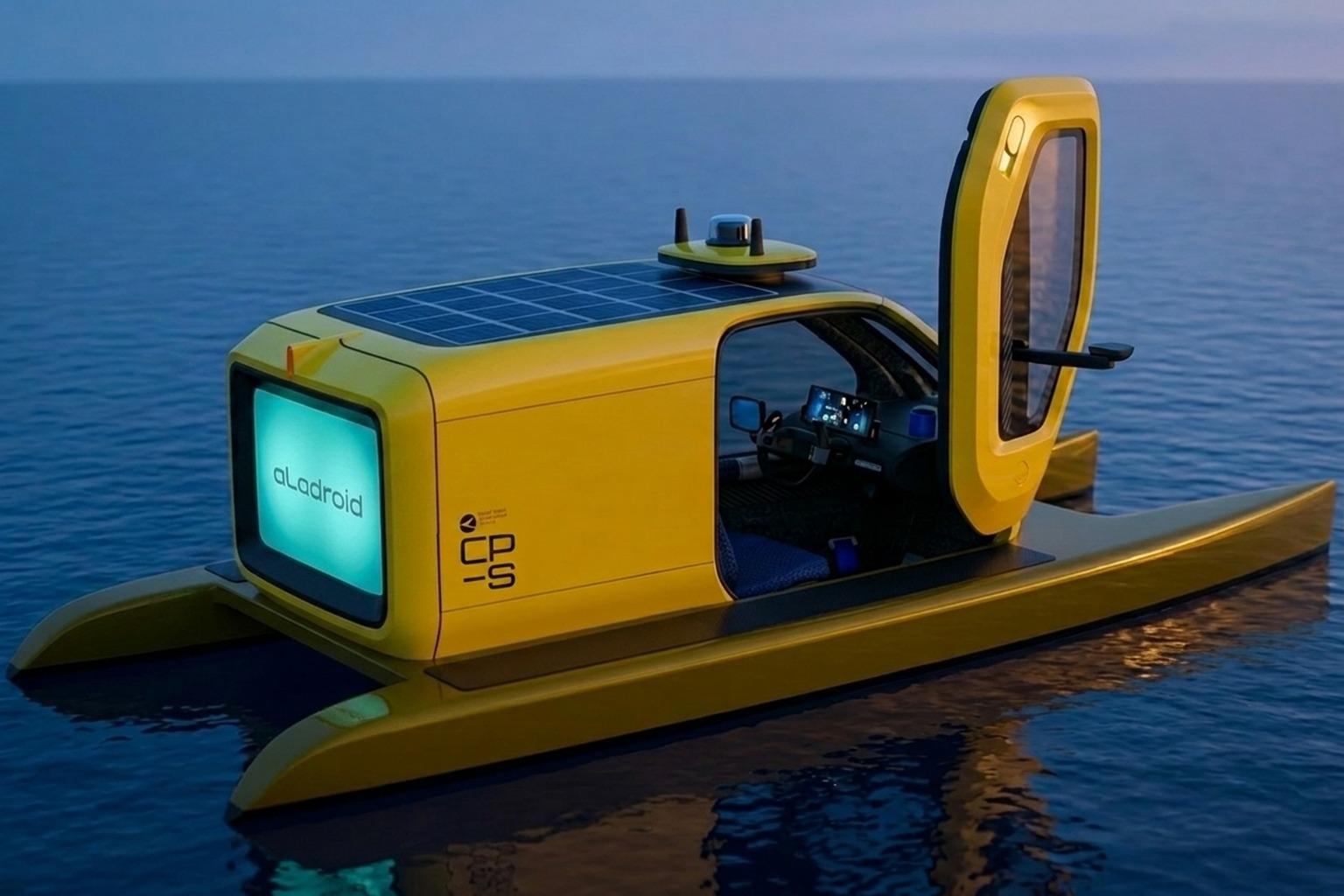
Sea: the same platform, on water.

The shared layer of the Cleverpod platform — battery, drive controller, software stack, sensor pack — does not change when the cabin is replaced by a hull. A coastal patrol, light cargo, or port-logistics vessel built on the CP04 Robotic Membrane is a credible long-horizon extension. It is shown here to make the platform's reach legible.

  • What stays the same

    The drive controller, the battery management, the telemetry, the operator software. Maritime variants reuse the same CleverPod Bridge unit and Remote Control Hub stack.

  • What changes

    Hull form, propulsion (marine drive), and corrosion-resistance treatment. These are well-understood maritime engineering scopes — not new platform invention.

  • Why it matters for Saudi

    Saudi's coastline runs over 2,640 km across the Red Sea and Persian Gulf. Oxagon, Red Sea Global, and AMAALA developments all involve maritime perimeter operations. The platform extends naturally into that demand without re-engineering the core.

CONCEPT Cleverpod sea variant — exploratory concept render
Concept rendering — illustrative only. No marine prototype is funded under the seed-stage capital plan.

Note Sea variant is exploratory and not in the seed-stage capital plan. No marine prototype is funded under the current ask.

Concept · platform potential, not in seed plan

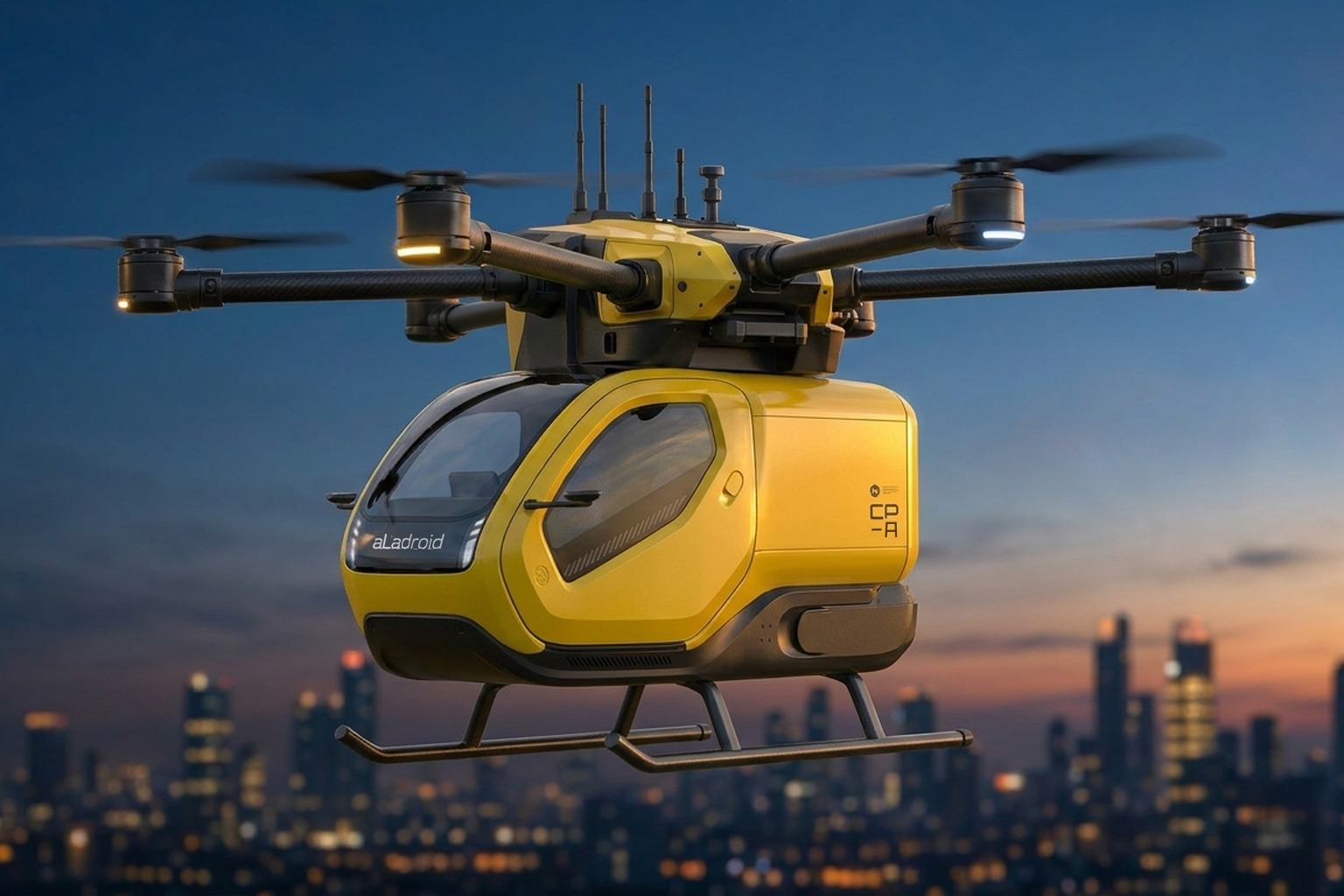
Air: the same platform, in flight.

CONCEPT Cleverpod air variant — exploratory concept render
Concept rendering — illustrative only. No airframe prototype is funded under the seed-stage capital plan.

An aerial variant of the CP04 Robotic Membrane reuses the platform's most expensive engineering — the battery, the controller, the software stack — and replaces the chassis with an airframe. Cargo drone, sensor drone, or coastal-overwatch frame are all credible roles. Like the sea variant, this is shown to make the platform's long-horizon reach visible, not to claim a near-term product.

  • What stays the same

    The battery management, the centralized controller, the telemetry stack.

  • What changes

    Airframe and rotor system, regulatory certification (GACA in Saudi). New scope, but adjacent to engineering already in the platform.

  • Why it matters for Saudi

    Saudi's GACA released a national drone strategy in 2024 explicitly targeting last-mile, agriculture, security, and emergency response. The platform fits each of those use cases without bespoke airframe development beyond the rotor system.

Note Air variant is exploratory and not in the seed-stage capital plan. No airframe prototype is funded under the current ask.

Competitive landscape

Four classes of comparable. None is a direct overlap.

The competitive map for a Saudi-incorporated subscription fleet manufacturer reads in four buckets, not one. Cargo three-wheeler imports are bare vehicles with no fleet-operations software, subscription wrapper, or Saudi-climate engineering; the PIF EV portfolio targets non-overlapping segments; the modular-EV graveyard failed for funding-architecture reasons that this venture is structurally counter-designed against; and the subscription-fleet operators are passenger-side, not delivery, and they don't operate in the Kingdom. Each row below names the non-replaceability dimension Cleverpod claims against that class.

01

Cargo three-wheeler imports

Mahindra Treo Zor, Piaggio Ape, Bajaj Maxima E-TEC — the cargo trikes of South Asia and adjacent markets. Each competes on the vehicle alone.

Mahindra Treo Zor India

India's market leader — but bought outright and run by the owner, with no telemetry and no Saudi-resident service network behind it.

Piaggio Ape Xtra India / EU

Still CNG/diesel, not even electric — and thermal cargo is an aftermarket bolt-on, not designed in.

Bajaj Maxima E-TEC India

The closest on paper — a recent EV — yet still just hardware: no fleet software, no subscription, no Kingdom presence.

Cleverpod edge

The imports compete on the vehicle; Cleverpod competes on the operating system around it. Each pod ships inside a managed smart-fleet stack — live telemetry, remote immobilisation, geofencing, biometric access, AI driver scoring — wrapped in a Saudi-resident subscription that carries the capex, service, insurance, and compliance an owner-operator otherwise shoulders alone. Layered on top: a cabin engineered for 45-50°C, built-in thermal cargo, and a road-to-market built with the regulator rather than around it — a supervised pilot today and a new premium class tomorrow (see Regulatory strategy). Replacing a Treo Zor swaps one vehicle for another; replacing Cleverpod means rebuilding the whole stack.

Source SASO Technical Regulation for Motorcycles · public manufacturer specifications
02

Saudi PIF EV portfolio

Ceer Motors, Lucid Motors, Hyundai-PIF JV. All target non-overlapping segments — luxury sedans, mid SUVs, ICE/EV passenger — none builds three-wheel cargo or runs a subscription fleet operator. Cleverpod is complementary inside the PIF mandate, not competitive.

Ceer Motors PIF / Foxconn

Saudi Arabia's national passenger-EV brand — mass-market sedans and SUVs at volume (240k/yr from late 2026). Consumer cars, not cargo.

Lucid Motors PIF anchor

PIF's luxury-EV play, now assembling in-Kingdom against a government fleet order. The top of the passenger price ladder — nowhere near commercial last-mile.

Hyundai-PIF JV 70/30, $500M

Affordable mass-market passenger cars, ICE and EV (50k/yr from 2026). Again a consumer segment, not a working fleet vehicle.

Cleverpod edge

These are not rivals to displace — they are the portfolio Cleverpod sits beside. PIF has already backed passenger EVs across the luxury, mid-market, and mass segments, but to our knowledge, none of them builds a commercial cargo or fleet vehicle. Cleverpod fills exactly that gap, under the same Vision 2030 industrial-localisation mandate and the same local-content goals. It adds a missing segment to the portfolio rather than competing inside it.

Source PIF press releases · Vision 2030 Industrials & Logistics ecosystem
03

Modular EV platform graveyard

Canoo, Arrival, Fisker, Lordstown, ELMS, Lion Electric, Proterra, VIA — EV startups that mostly went public via SPAC in the 2020–21 boom and then failed between 2022 and 2025. The common thread is not the product; it is the money: one-time equity raised at the top of the cycle, cash burned far faster than vehicles shipped, order books that never converted to volume, and no way to raise more once the market turned.

Arrival Administration, 2024

UK-based, Nasdaq-listed via SPAC. Bet everything on robotic 'microfactories' meant to build vehicles in-house — unproven and cash-hungry. Restructured repeatedly, was delisted, and entered administration in early 2024 without ever building at scale; even a 10,000-van UPS order never turned into volume.

Canoo Chapter 7, Jan 2025

Nasdaq-listed via SPAC. Bought Arrival's manufacturing assets at an ~80% discount in 2024, then liquidated months later. Had marquee names — Walmart, NASA, USPS, DoD, Oklahoma — but shipped only a handful of vans; cash burn dwarfed revenue and both the US DOE loan and foreign-capital talks fell through.

Fisker / Lordstown / ELMS All bankrupt

The same shape across very different vehicles — a passenger crossover, a pickup, delivery vans: SPAC cash raised once, a production ramp that stalled, and no fresh capital when the window closed.

Lion Electric · Proterra · VIA Insolvent or distressed

Adjacent electric bus and truck plays that hit the same wall: heavy upfront capital, slow to volume, and a financing base too thin to bridge to scale.

Cleverpod edge

Funding architecture, not just better hardware. The planned anchor is a long-horizon strategic investor that underwrites through the cycle rather than one-time retail SPAC capital; revenue is recurring subscription in a single Saudi vertical, not hardware sold against orders that may never convert; and the model adds asset-backed fleet financing from the Growth stage rather than relying on pure equity throughout.

Source Court filings · S-1 / 10-K disclosures · industry trade press
04

Subscription fleet operators

Lyft Flexdrive, Onto, Kyte, FairPlay. Passenger-side, not delivery, and none operates in Saudi Arabia. The closest referent for the wrapper is Moove — vehicle subscription and financing for ride-hailing and delivery drivers, headquartered in Dubai and profitable in the UAE. Moove is the evidence that a subscription fleet works in the Gulf rather than an argument against one: it finances standard vehicles for individual drivers, where Cleverpod operates a purpose-built delivery fleet with the service, insurance and compliance stack bundled — and it is not in the Kingdom.

Lyft Flexdrive US

Passenger driver subscription. No delivery analogue, no Saudi presence.

Onto UK

EV subscription for consumers. Not commercial fleet.

Kyte US

Short-term car subscription. Passenger.

Moove (referent) Dubai HQ · UAE, India, UK, Africa

Vehicle subscription and financing for ride-hailing and delivery drivers; ~USD 400M ARR, EBITDA-breakeven, profitable in the UAE. Same wrapper discipline, on standard vehicles financed to individual drivers. Not in Saudi Arabia.

Cleverpod edge

Distribution asymmetry + market timing. Saudi has no subscription delivery analogue; the SASO bar on imported cargo trikes, combined with the courier-licensing reform of April 2024 and a regulator that pilots new vehicle types before standardising them, means a subscription fleet operator with Saudi-spec hardware and a pilot-to-standard road map is uniquely positioned, with no incumbent to displace.

Source Operator press releases · Saudi courier-licensing reform 2024

Cleverpod is not 'the Mahindra of Saudi' or 'the Ceer of cargo'. It is the company that holds all four edges simultaneously: a Saudi-resident fleet, service, insurance, and compliance stack; complementary positioning inside the PIF mandate; financing architecture designed against the modular-EV graveyard's failure mode; and a subscription wrapper with no incumbent to displace.

Regulatory strategy · the road to market

Not built to dodge the law.
Built to set the bar.

A purpose-built cargo three-wheeler has no settled home in Saudi vehicle law today: the cheap imported trike is barred, and the moped classes were never written for a 20 kW, airbag-equipped, climate-controlled pod. Rather than contort the vehicle to fit an old category, Cleverpod proposes the path the Kingdom has already proven with autonomous vehicles — deploy under a supervised pilot permit now, then co-author a new premium class set high enough to keep Saudi roads world-class.

  1. 01

    Today — deploy under a supervised pilot permit

    Saudi Arabia already runs this exact playbook. The Transport General Authority's regulatory sandbox put vetted operators' autonomous vehicles on Riyadh's public roads under supervision — geofenced, telemetered, reviewed — expressly to help regulators write the rules that followed (the SASO autonomous-vehicle technical regulation and Saudi Highway Code Vol. 801, entering force in 2026). Cleverpod proposes the same route: a controlled, geofenced delivery pilot under TGA oversight. The CP02 is built for it — live telemetry, 360° cameras, and remote immobilisation are standard, so every pilot kilometre is logged, supervised, and auditable.

  2. 02

    Tomorrow — a new premium cargo three-wheeler class

    The pilot's purpose is a new vehicle class, defined by a deliberately high engineering bar: a top speed of at least 100 km/h, so the vehicle moves with traffic on every road instead of obstructing it; a liquid-cooled battery, for thermal safety through a 45–50°C summer; and an enclosed safety cabin with airbag and three-point belts. That bar does two things at once. It keeps cheap, slow, unsafe imports off Saudi roads — protecting the order and quality of the Kingdom's streets — and it makes room for the kind of futuristic, purpose-built three-wheeler that belongs on a Vision 2030 road. The CP02 is engineered to clear every line of it.

  3. 03

    Licence continuity through the transition

    The proposed class keeps motorcycle-licence eligibility for a defined transition window. That matters for adoption: today's courier workforce is largely expatriate and motorcycle-licensed, and Saudization is a trajectory, not an overnight switch. Licence continuity lets that workforce keep operating from day one, while the air-conditioned cabin steadily turns delivery into indoor, dignified work a Saudi national will take — moving the operator base toward Nitaqat targets over time instead of stranding the fleet on day one. A high-speed three-wheel class also avoids forcing every operator onto a full passenger-car licence, which a four-wheel reclassification would require.

Why this is the real moat

The company that runs the pilot, meets the highest bar, and sits at the table while the class is written is the hardest to displace — not because of a loophole, but because it helped define the standard everyone else must later meet. Layered on the Saudi-resident fleet, service, insurance, and compliance stack, first-mover-plus-standard-author is a far more durable position than any single certificate. It is also precisely the role a sovereign investor is best placed to enable.

Objections handled

The hard questions, in order.

Every objection here has come up in live conversations. Each gets a direct response, and points to the modeled evidence where it exists.

Q01 Why does the cap table price only one product if the venture is a manufacturer?

Discipline. The case has two parts — the delivery cash cow (the CP02 subscription business, Saudi first then GCC) and the build-out of the full range (CP02 hardware sales, CP03–CP04 vehicles, IP licensing, sea / air variants). The financial model prices the cash cow only because that is the part with production-intent hardware (CP02, validated forward from the CP01 prototype), validated unit economics, and month-by-month projections through 2030. The full-range build-out is real engineering, but it is not assumed in the headline IRR or MOIC. PIF gets the underwritten number on the cover page; the upside is roadmap, not promise.

Q02 How much of the platform thesis is real, versus marketing?

The CP01 hardware is a validated prototype, with engineering documentation and a Bill of Materials in the data room — and a Dubai last-mile operator running 450+ riders has confirmed demand for the CP02 in writing. The CP02 takes that engineering forward to production-intent design and is the model the planned Saudi fleet is to be built from. CP02–CP04 share the same drive, battery, and CleverPod Bridge controller — that is what makes the platform claim structural rather than rhetorical.

Q03 Sea and air variants — are you planning to build those with seed money?

No. The sea and air slides carry a 'platform potential, not in seed plan' label and the seed-stage capital plan does not allocate against either. They are shown to make the platform's reach legible, because the same drive, battery, and software stack does extend that far in principle. Building either one becomes a separate funding decision after the cash cow is paying its own way.

Q04 Why Saudi first — isn't UAE the obvious regional launchpad?

Three concrete reasons, not a process of elimination. Scale: Saudi Arabia is the GCC's largest e-commerce market, so the absolute delivery volume a subscription fleet addresses is bigger here than anywhere else in the region. A regulatory opening unique to the Kingdom: SASO's motorcycle regulation keeps imported cargo trikes off Saudi roads, removing the cheap low-cost substitute, while the Kingdom's proven pilot-permit-to-new-class process — the same sandbox route used for autonomous vehicles — gives a compliant, Saudi-registered operator a credible road to market (see Regulatory strategy). Capital and policy alignment: PIF's 2026–2030 strategy names Industrials & Logistics a priority ecosystem with a localization mandate. UAE is the regional default, which is precisely why it is a crowded fleet market with little room for a subscription entrant at early-stage scale; it stays a GCC expansion target, not the first move.

Q05 Is the CP02 even legal on Saudi roads today?

Not yet as an off-the-shelf category — that is the go-to-market by design. A purpose-built cargo three-wheeler sits between two regimes: the SASO motorcycle regulation (which bars imported cargo trikes) and the EV technical regulation (which homologates electric vehicles by propulsion). Rather than force the CP02 into the moped class it has outgrown, the plan follows the route the Kingdom has already proven for new vehicle types: deploy under a supervised TGA pilot permit — the same sandbox mechanism that put autonomous vehicles on Riyadh roads ahead of formal rules — and use that pilot to co-author a new premium cargo three-wheeler class (≥100 km/h, liquid-cooled battery, enclosed safety cabin). The CP01 prototype is validated engineering proof the platform works; it is not the CP02's road pathway. The full sequence is set out in the Regulatory Strategy section.

Q06 Why would a subscriber pick you over just buying a Chinese EV cheaply?

The subscriber is comparing a predictable monthly service fee to a lumpy total cost of ownership: vehicle, battery, maintenance, insurance, compliance, downtime, training, resale risk. Our number is higher on the sticker; the TCO is lower for any operator that values uptime and compliance. We are not competing with the sticker price — we are competing with the real cost of running a small fleet without infrastructure.

Q07 How is the headline return derived — is it back-solved?

No. Each round is priced independently — a fixed pre-revenue seed value, then forward run-rate-revenue multiples that compress round on round. The return is modelled as a long hold: PIF draws dividends once the fleet self-finances, then exits once on a defensible EV/EBIT multiple, net of fleet debt, set below the multiple the model's mature-WACC DCF implies. IRR (~40.6%), MOIC (27.8×) and NPV follow from those inputs. The exit dominates the return, but the annualised figure is not knife-edge on its date: a 12-month slip moves the IRR by ~3 points.

Q08 Is the Seed pre-money defensible, or just asserted?

The proposed Seed pre-money is SAR 232.0M. It is not presented as a revenue multiple: it is the entry price for a platform moving from a validated prototype to a production-intent CP02 and Saudi deployment. The investor is buying into the existing CP01 engineering, vehicle and software IP, the CP02 development programme, a signed operator LOI, and the Saudi market-entry pathway. Seed proceeds fund defined de-risking milestones across production design, certification, Saudi assembly readiness, software, and initial deployment preparation. Those assets and milestones are the basis for assessing the Seed mark; later rounds move to forward-revenue pricing once operating evidence exists, with valuation and ownership sensitivity set out in the data room.

Q09 What kills it?

Three things, in order. First, adoption pace: this is a subscription fleet, so if operators are slower to switch from owning motorcycles than planned, utilization stays below break-even and the cash cow never starts producing — the single biggest risk. Second, hardware in the real duty cycle: if the pod's reliability, battery life, or A/C performance degrades faster in sustained 45–50°C use than the bench data suggests, service cost overruns eat the per-pod margin. Third, capital continuity: the plan stages four equity rounds through Expansion, so a round that stalls midway leaves it short of runway before the delivery business carries itself. Regulatory reversal and a cost-of-capital shock sit behind these — possible, but less likely than simply ramping too slowly or under-building the service operation.

Q10 Who holds more at exit — the founders or PIF?

PIF does. After the fleet financing, the Seed entry price and the subsequent rounds, PIF holds about 43% to the founders' ~33% at Expansion, so at exit PIF takes the larger cheque. The founders retain a substantial ~33% for building the platform and the IP, and PIF's participating 1× preference returns its ~SAR 315.2M capital first.

Q11 Doesn't customer churn break the prepaid, zero-receivables working-capital story?

No, and the reason is structural, not optimistic. The subscription is prepaid — cash precedes service — so receivables and bad-debt risk are minimal. And demand is market-share-driven across a large, growing national fleet, not a handful of contracts: the pods are modular and redeployable, so a unit no longer needed by one operator or in one city is redeployed to another. There is no stranded asset and no churn write-off the way a single-customer lease would carry. That is what makes the model's negative working capital structural — customers pay a month ahead while suppliers are paid on terms — and the model still takes prudence on top: a 1% payment-default haircut on subscription revenue and a 3–5% fleet-vacancy allowance are netted against the plan.

Q12 How sensitive is the valuation to the 25% share assumption and the discount rate?

Materially. Essentially all of the long-run value sits in the post-2030 continuation, which ramps Cleverpod to a 25% steady-state share of the Saudi last-mile fleet. At a 10–15% steady state the value is far lower, and the enterprise DCF is likewise discount-rate sensitive — the full sensitivity table is in the data room. The 25% level rests on a pod that is safer and cooler than an open motorcycle in 45–50°C heat, carries integrated fleet management a bare vehicle cannot, and rides the Kingdom's renewable-electrification mandate. The exit multiple is set below the model's mature-WACC DCF-implied multiple.

Team and governance

Two founders, an engineering bench, and governance set round by round.

Cleverpod is led by two founders — Alexander Yuryev on product, the vehicle, and engineering, and Benedikt Wagner on finance, capital, and the Saudi build-out — drawing on a bench of highly skilled Russian and Chinese engineers. The Saudi entity, once incorporated, runs operations, commercial, and finance; engineering and procurement are delivered through the Shenzhen R&D and Procurement entities under transfer pricing. PIF leads the priced rounds; ownership and governance are set round by round, with board representation and a participating preference.

Alexander Yuryev

Alexander Yuryev

Founder & CEO

Founder and CEO of Cleverpod. A deep-tech founder and inventor based in Shenzhen, he owns the platform thesis, the vehicle concept, and the engineering direction, and leads the company's engineering teams across Russia and China. Fluent in Russian, Mandarin and English.

Benedikt Wagner

Benedikt Wagner

Co-founder · CFO and Investor Relations

Co-founder, CFA, Oxford graduate. Owns the financial model, the capital plan, and the Saudi entity build-out — MISA incorporation, PIF engagement, and the cap table sit here. Fluent in German, English and Russian.

G01

Staged, priced financing

PIF invests in priced equity rounds across the financing stages, each sized by the financial model. Ownership grows round by round as new capital comes in; the model provides a transparent basis for valuation discussion at each stage.

G02

Separate entities, one consolidated model

The Saudi entity owns the brand, the subscriber contracts, the fleet, and the revenue. Shenzhen provides cost-plus R&D and procurement. Transfer pricing is explicit — HNTE-qualified where applicable — and the model reports both consolidated and per-entity P&L.

G03

Board construction (proposed terms)

At the priced round, board seats proportional to ownership, an independent Saudi-resident director seat from close, and reserved matters (budget, headcount gates, material capex, new debt) requiring investor consent.

G04

Investor protections

PIF equity carries a participating 1× liquidation preference — it recovers its capital ahead of the founders and then participates pro-rata in the upside, wired into the exit waterfall in the model. Broad-based weighted-average anti-dilution, pro-rata / pre-emptive, and drag / tag are documented at the round; founders vest over four years with a one-year cliff from Seed close. The participating preference, the co-investor split and founder vesting are carried in the model; the remaining protections are term-sheet items documented at the round.

Estimated cap table — stage-by-stage ownership

Projected PIF / sovereign ownership across the financing stages, founders' retention, and implied ESOP + other pool. All figures are pulled from the Cap Table sheet of the financial model — they describe the intended ownership path, not a current cap table.

  SeedLaunchGrowthExpansion
Sovereign / PIF ownership src CT_Saudi_Ownership_* · Cap Table · the financial model 31.2%42.2%43%43%
Founders' ownership src CT_Founder_Ownership_* · Cap Table · the financial model 58.8%35%33.4%33.4%
Implied ESOP + other 10%22.7%23.6%23.6%
Pre-money (SAR) 232.0M423.7M1.5B3.4B
Post-money (SAR) 337.0M682.7M1.6B3.4B
ESOP reserve
10%
src CT_ESOP_Pool_Pct · Funding & Macro Inputs · the financial model
ESOP is held at the Saudi entity for operator and senior-hire grants. Founders' dilution is structured as staged vesting.
Capital plan

Four stages, with an auditable cash bridge at each.

The model projects the business forward monthly through 2030 across four stages. Each stage has a defined capital injection, a set of operating targets, and a projected cash bridge that balances to the consolidated cash flow statement. This is the same bridge the Executive Summary dashboard prints — no second set of numbers.

Stage cash bridge — operating, investing and financing flows
Bars reconcile stage-total operating and investing cash flow with equity issuance and fleet-debt issuance; net cash change is shown alongside. Values come from Consolidated CF + BS Helpers. The stage cards show total equity raised and PIF's portion.
Operating cash flow Investing cash flow Equity issuance Fleet-debt issuance Net change in cash
01
Seed (2026)

Saudi entity incorporated, MISA licensing secured, first fleet prototype deployed, pilot subscriptions targeted.

Equity raised (this stage)
SAR 105.0M
of which PIF
SAR 105.0M
Revenue at stage end (monthly)
SAR 507.7K
Annual run-rate
SAR 6.1M
02
Launch (2027)

First commercial fleet (three-digit pod count), fleet service infrastructure stood up, second Saudi city entered.

Equity raised (this stage)
SAR 259.0M
of which PIF
SAR 168.4M
Revenue at stage end (monthly)
SAR 11.7M
Annual run-rate
SAR 140.9M
03
Growth (2028)

Fleet scaling across Riyadh, Jeddah, Dammam; software productized; transfer pricing and HNTE fully in place.

Equity raised (this stage)
SAR 64.4M
of which PIF
SAR 41.9M
Revenue at stage end (monthly)
SAR 45.8M
Annual run-rate
SAR 549.7M
04
Expansion (2029)

GCC pilot (bonus, not thesis) and the operator marketplace. The Saudi plan raises no new equity here — by this stage it funds itself, and the last priced round is Growth in 2028. Taking the pod beyond the Kingdom is not costed in the model and would be its own capital decision.

Equity raised (this stage)
SAR 0.0
of which PIF
SAR 0.0
Revenue at stage end (monthly)
SAR 143.1M
Annual run-rate
SAR 1.7B
Returns

A hold, not a flip. One exit carries the return.

PIF's return is modelled as a hold rather than a flip: capital across four priced rounds through 2029, dividends once the fleet self-finances, then a single EV/EBIT exit (net of fleet debt) set below the multiple the model's mature-WACC DCF implies. The timing is an assumption, not a forecast — the model holds for seven years after the plan window closes, which puts the exit near 2037 on roughly an eleven-year horizon, and a year's slip moves the IRR by about three points. The shape is firmer than the date: the dividends are real but secondary, and the exit carries ~89% of PIF's proceeds. IRR, MOIC, NPV and the cash schedule live on the Cap Table and DCF+GGM sheets, each with a source pill to its named range. PIF is modeled as the lead but not the sole equity investor, and essentially all long-run value rests on the post-2030 share ramp, shown with its sensitivity. A comps table sits alongside.

PIF MOIC
27.8×
Multiple on invested capital
src CT_Saudi_MOIC · DCF+GGM · the financial model
PIF NPV
SAR 994.6M
Discounted at the model WACC
src CT_Saudi_NPV · DCF+GGM · the financial model
Exit value (9.5× EV/EBIT)
SAR 17.0B
9.5× EV/EBIT on exit-year earnings, net of fleet debt — below the model's mature-WACC DCF-implied multiple. Not a DCF output, not a revenue multiple.
src VAL_Exit_Value_EV_EBIT · DCF+GGM · the financial model
PIF IRR (annualized)
40.6%
Annualized XIRR on modeled PIF cash flows
src CT_Saudi_IRR · DCF+GGM · the financial model
Valuation sensitivity — post-2030 steady-state share

The continuation case is sensitive to the steady-state share of the Saudi last-mile fleet. The model calculates five points from 15% to 35%; the table presents the 15% downside, 25% base case, and 35% upside. Driver: MS_PostModel_Target.

Case Steady-state share Enterprise value (SAR) PIF MOIC PIF IRR
downside 15% SAR 626.6M 16.5× 33.1%
base case 25% SAR 1.5B 27.8× 40.6%
upside 35% SAR 2.2B 38.9× 45.1%
Indicative comparables

Three comparables, each marked within the last 18 months, with the basis of every multiple shown.

Company Category Geography Valuation marker Source
Moove Vehicle subscription and financing for ride-hailing and delivery drivers — the closest structural twin Dubai HQ · ~12 markets incl. UAE USD 750M at the USD 100M Series B (Mar 2024, Uber and Mubadala). Reported Sep 2025 to be raising at USD 2bn+ on ~USD 400M ARR — ≈5× revenue. An equity mark: EV/Revenue is higher again on a debt-funded fleet book. Mubadala (Mar 2024) · Bloomberg (Sep 2025 — reported, not confirmed closed)
Zypp Electric EV-as-a-service rentals to delivery gig riders — same customer and same subscription revenue, on two-wheelers India ~USD 335–350M in the ongoing Series C (Jan 2025) against an INR 600 Cr (~USD 72M) FY26 revenue target — ≈4.7× forward revenue. ~22,000 vehicles; EBITDA-positive since Jul 2025. Entrackr (Jan 2025) · company disclosures
Euler Motors Cargo three-wheeler OEM, in production — sells vehicles rather than operating a subscription fleet India GIC-led USD 60M Series C (Oct 2022), Hero MotoCorp-led ~USD 75M Series D (May 2025), Lightrock-led ~USD 47M Series E (Mar 2026). Round valuations undisclosed — Hero's 32.1% for ~USD 72M implies ≈USD 225M, an inference rather than a mark. FY25: 3,050 units, INR 192.3 Cr (~USD 23M) revenue, loss-making. TechCrunch · Entrackr · company disclosures

Comparables are for orientation, not claims of equivalence. Only Moove shares the structure of this plan — a subscription fleet financed on its own balance sheet. Zypp runs the same delivery-rider customer on two-wheelers. Euler is an OEM: it sells vehicles, so its mark prices the manufacturing business this model deliberately excludes, and it sits here as a hardware reference rather than a valuation basis. Private marks are post-money equity, not enterprise value, so a debt-funded fleet book carries a higher EV/Revenue than the ratio shown. None of the three operates in Saudi Arabia, and all three are loss-making or only recently at breakeven — which is the distance between a revenue multiple and the earnings basis this plan exits on. Cleverpod is also earlier-stage and geographically focused; a single-country subscription fleet operator at scale is genuinely rare.

The ask

Priced Seed equity round — into the planned Saudi operating company.

Seed-stage capital is raised as a priced equity round into the planned Saudi operating company once incorporated. The model-derived bridge reconciles the round across operating cash burn, investing cash flow and Seed closing cash; pre-money and round size come from named ranges in the financial model. Specific terms are available for review.

Seed priced equity round — amount sized to the full Seed-stage cash bridge
SAR 105.0M
src CT_Capital_Raised_Seed · Cap Table · the financial model
Seed pre-money SAR 232.0M
Seed post-money SAR 337.0M
PIF ownership after Seed 31.2%

Seed-round cash bridge

Seed round SAR 105.0M src CT_Capital_Raised_Seed · Cap Table · the financial model
  • Operating cash burn src CG_CF_CFO · Consolidated CF · the financial model SAR 12.6M 12%
  • Investing cash flow (capex) src CG_CF_CFI · Consolidated CF · the financial model SAR 63.6M 60.6%
  • Closing cash reserve src CG_BS_Cash · Consolidated BS · the financial model SAR 28.8M 27.4%

Model-derived for the full Seed stage. Operating cash burn, investing cash flow and closing cash reconcile to the round.

Stage roadmap by year

  1. 01
    2026

    Entity incorporated, pilot pods deployed

    MISA license issued, Saudi entity incorporated, statutory capital paid in. First pilot pods deployed with paying pilot subscribers. Software and operations playbook validated in the field.

  2. 02
    2027

    First commercial fleet, second city

    Three-digit pod count, two Saudi cities live, positive per-pod contribution, first cohort renewal data. The 2027 priced equity round is raised around this point.

  3. 03
    2028

    Riyadh · Jeddah · Dammam at scale

    Fleet scaled nationally, HNTE tax status secured, software productised, operator training institutionalised. First full-year positive operating cash.

  4. 04
    2029

    GCC pilot and the operator marketplace

    UAE / Kuwait pilot (bonus, not thesis). Operator marketplace operational. The Saudi plan raises no new equity at this stage — the last priced round is Growth in 2028 — though a GCC build-out would be funded separately and is not in these numbers. The exit sits outside this roadmap: the model holds for seven years after the plan window closes, putting a single EV/EBIT trade near 2037 — an assumption, not a scheduled event.

PIF IRR
40.6%
src CT_Saudi_IRR · Cap Table · the financial model
PIF MOIC
27.8×
src CT_Saudi_MOIC · Cap Table · the financial model
2029 post-money
SAR 3.4B
src CT_PostMoney_Expansion · Cap Table · the financial model
2028 post-money (ref)
SAR 1.6B
src CT_PostMoney_Growth · Cap Table · the financial model

Explore the model

The headline returns and unit economics on this page are pulled live from named ranges in the financial model; narrative and market-sizing figures are stated from the same model and cited third-party sources. The full model, the staged equity capital plan, and the term sheet are available for review.

View the financial model